The Sun
The Sun is a yellow dwarf star (G2V), about 4.6 billion years old, and the dominant gravitational force in the Solar System. It has a diameter of roughly 1.4 million kilometers and contains around 99.8% of the Solar System’s mass. Nuclear fusion in its core converts hydrogen into helium, producing energy that warms the planets. Above the core lie the radiative and convective zones, followed by the visible photosphere (~5,500 °C), the chromosphere, and the much hotter corona (~2 million °C).
Source: science.nasa.gov
APODs including "The Sun"
A Venus Transit Over the Baltic Sea
13/06/2012
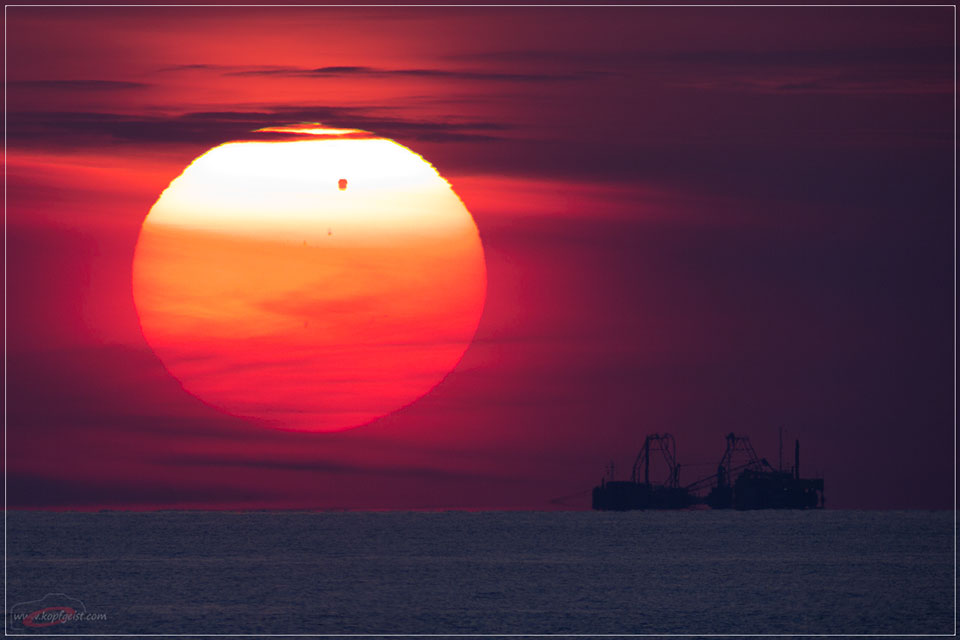
Waiting years and traveling kilometers -- all to get a shot like this. And even with all of this planning, a good bit of luck was helpful. As the Sun rose over the Baltic Sea last Wednesday as seen from Fehmarn Island in northern Germany, photographer Jens Hackmann was ready for the very unusual black dot of Venus to appear superimposed. Less expected were the textures of clouds and haze that would tint different levels of the Sun various shades of red. And possibly the luckiest gift of all was a flicker of a rare green flash at the very top of the Sun. The above image is, of course, just one of many spectacular pictures taken last week of the last transit of the planet Venus across the face of the Sun for the next 105 years. Vote: APOD entered in Three Quarks Daily 2012 Science Writing Contest