The Sun
The Sun is a yellow dwarf star (G2V), about 4.6 billion years old, and the dominant gravitational force in the Solar System. It has a diameter of roughly 1.4 million kilometers and contains around 99.8% of the Solar System’s mass. Nuclear fusion in its core converts hydrogen into helium, producing energy that warms the planets. Above the core lie the radiative and convective zones, followed by the visible photosphere (~5,500 °C), the chromosphere, and the much hotter corona (~2 million °C).
Source: science.nasa.gov
APODs including "The Sun"
Venus Transits the Midnight Sun
20/06/2012
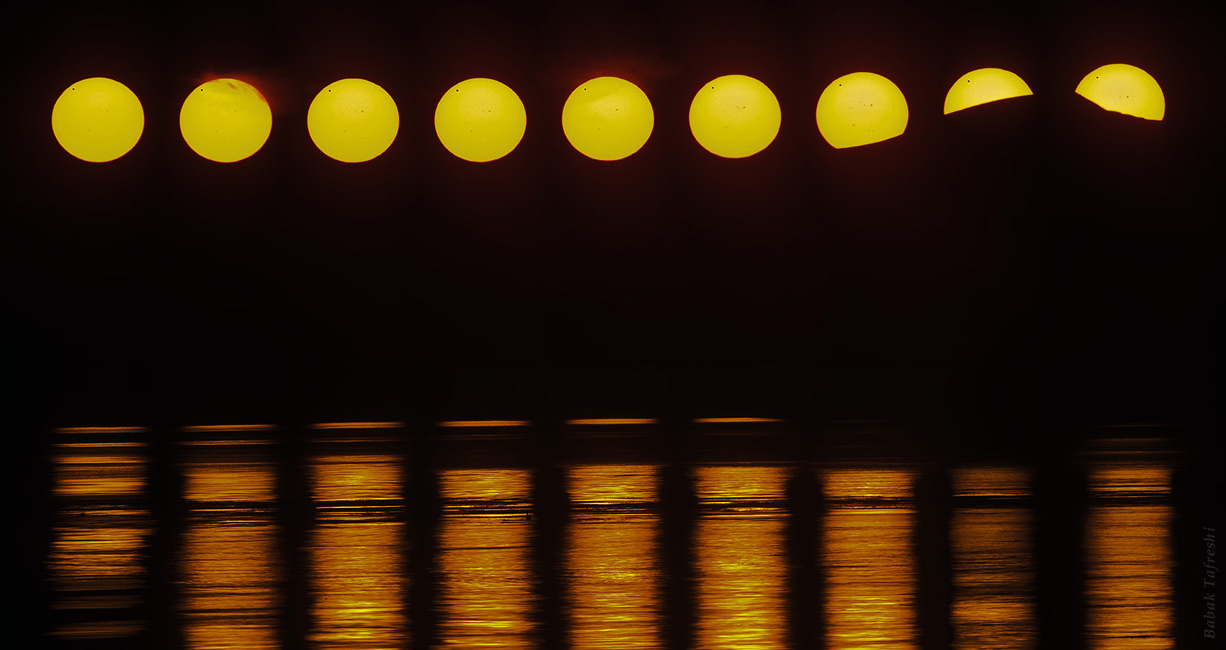
Today's solstice, the astronomical beginning of summer in the north, is at 23:09 UT when the Sun reaches the northernmost declination in its yearly trek through planet Earth's sky. While most in the northern hemisphere will experience the longest day of the year, for some the Sun won't set at all, still standing just above the horizon at midnight as far south as about 66.6 degrees northern latitude. Of course, as summer comes to the north the midnight Sun comes earlier to higher latitudes. Recorded near midnight, this time series from June 6 follows the Sun gliding above a mountainous horizon from a latitude of 69 degrees north. The remarkable scene looks north over the Norwegian Sea from Sortland, Norway. The 2012 transit of Venus is already in progress, with Earth's sister planet in silhouette at the upper left against the bright disk of the midnight Sun.