The Sun
The Sun is a yellow dwarf star (G2V), about 4.6 billion years old, and the dominant gravitational force in the Solar System. It has a diameter of roughly 1.4 million kilometers and contains around 99.8% of the Solar System’s mass. Nuclear fusion in its core converts hydrogen into helium, producing energy that warms the planets. Above the core lie the radiative and convective zones, followed by the visible photosphere (~5,500 °C), the chromosphere, and the much hotter corona (~2 million °C).
Source: science.nasa.gov
APODs including "The Sun"
Northern Green Flash
23/06/2012
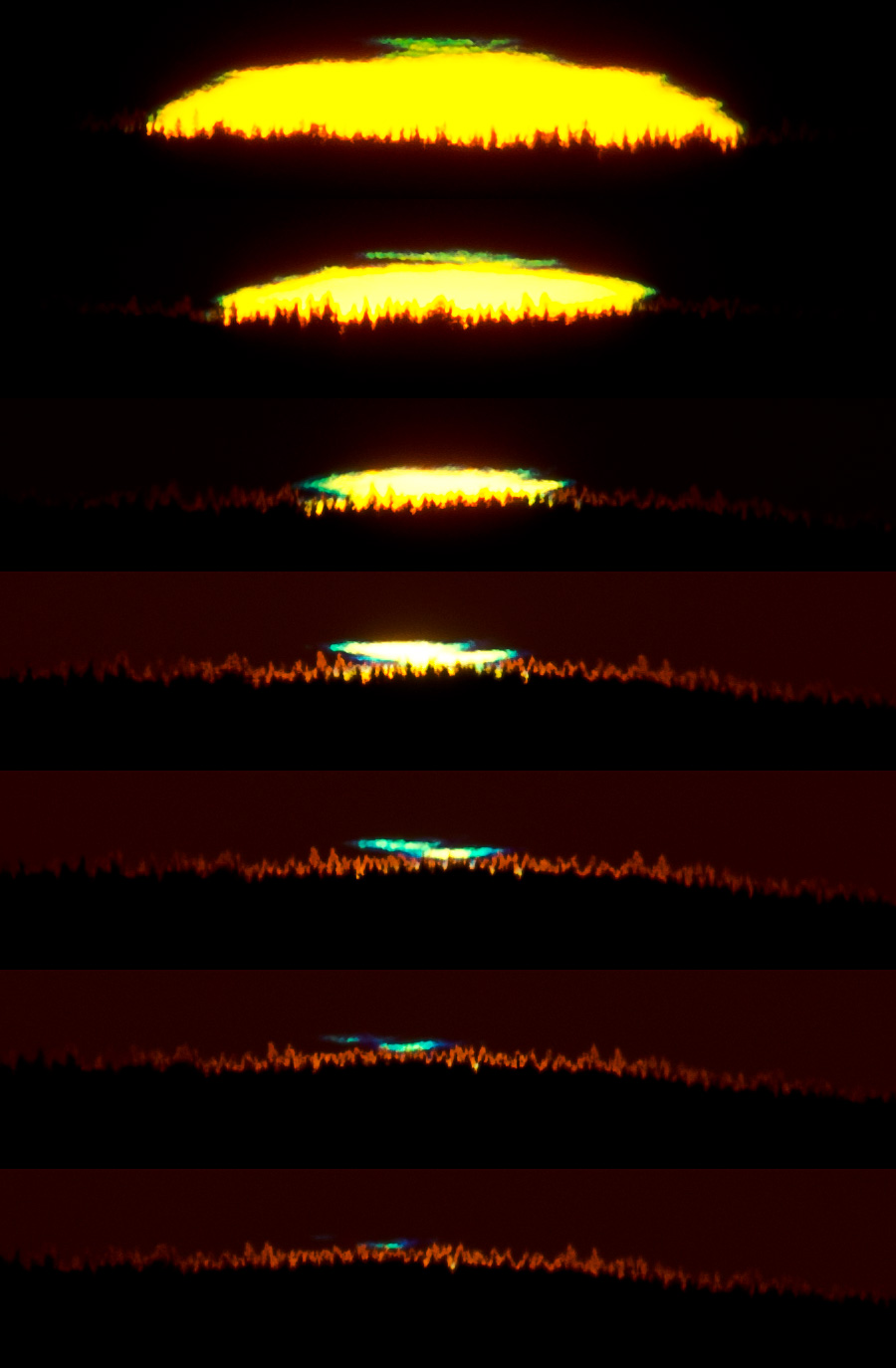
As seen from Frösön island in northern Sweden the Sun did set a day after the summer solstice. From that location below the arctic circle it settled slowly behind the northern horizon. During the sunset's final minute, this remarkable sequence of 7 images follows the distorted edge of the solar disk as it just disappears against a distant tree line, capturing both a green and blue flash. Not a myth even in a land of runes, the colorful but elusive glints are caused by atmospheric refraction enhanced by long, low, sight lines and strong atmospheric temperature gradients.