The Sun
The Sun is a yellow dwarf star (G2V), about 4.6 billion years old, and the dominant gravitational force in the Solar System. It has a diameter of roughly 1.4 million kilometers and contains around 99.8% of the Solar System’s mass. Nuclear fusion in its core converts hydrogen into helium, producing energy that warms the planets. Above the core lie the radiative and convective zones, followed by the visible photosphere (~5,500 °C), the chromosphere, and the much hotter corona (~2 million °C).
Source: science.nasa.gov
APODs including "The Sun"
A Sundial that Shows Solstice
26/06/2012
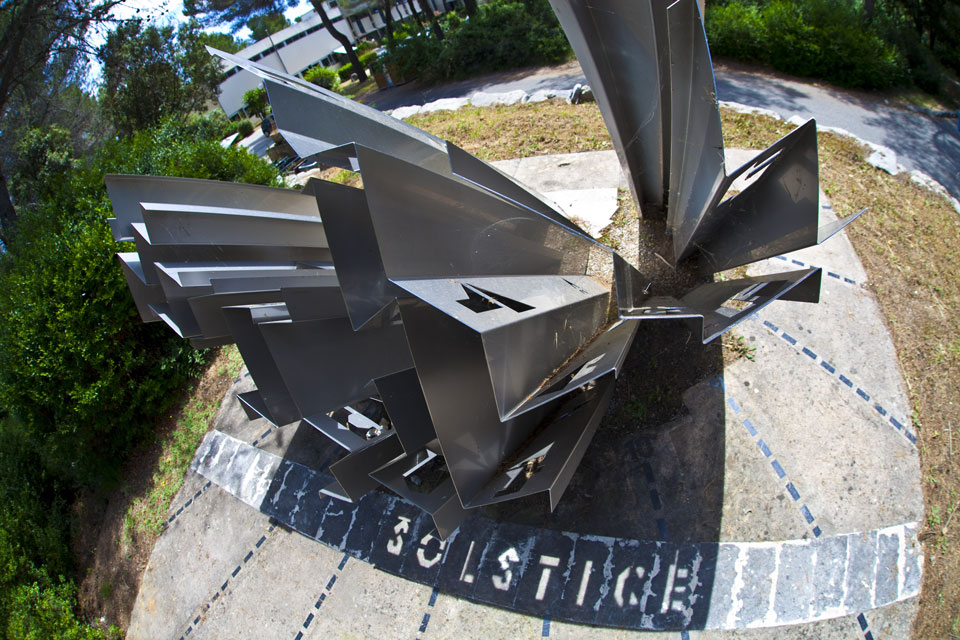
What time is it? If the time and day are right, this sundial will tell you: SOLSTICE. Only then will the Sun be located just right for sunlight to stream through openings and spell out the term for the longest and shortest days of the year. And that happened last week and twice each year. The sundial was constructed by Jean Salins in 1980 and is situated at the Ecole Sup�rieure des Mines de Paris in Valbonne Sophia Antipolis of south-eastern France. On two other days of the year, watchers of this sundial might get to see it produce another word: EQUINOXE. Resource Guide: NASA Education and Public Outreach