The Sun
The Sun is a yellow dwarf star (G2V), about 4.6 billion years old, and the dominant gravitational force in the Solar System. It has a diameter of roughly 1.4 million kilometers and contains around 99.8% of the Solar System’s mass. Nuclear fusion in its core converts hydrogen into helium, producing energy that warms the planets. Above the core lie the radiative and convective zones, followed by the visible photosphere (~5,500 °C), the chromosphere, and the much hotter corona (~2 million °C).
Source: science.nasa.gov
APODs including "The Sun"
Fifth Moon Discovered Orbiting Pluto
16/07/2012
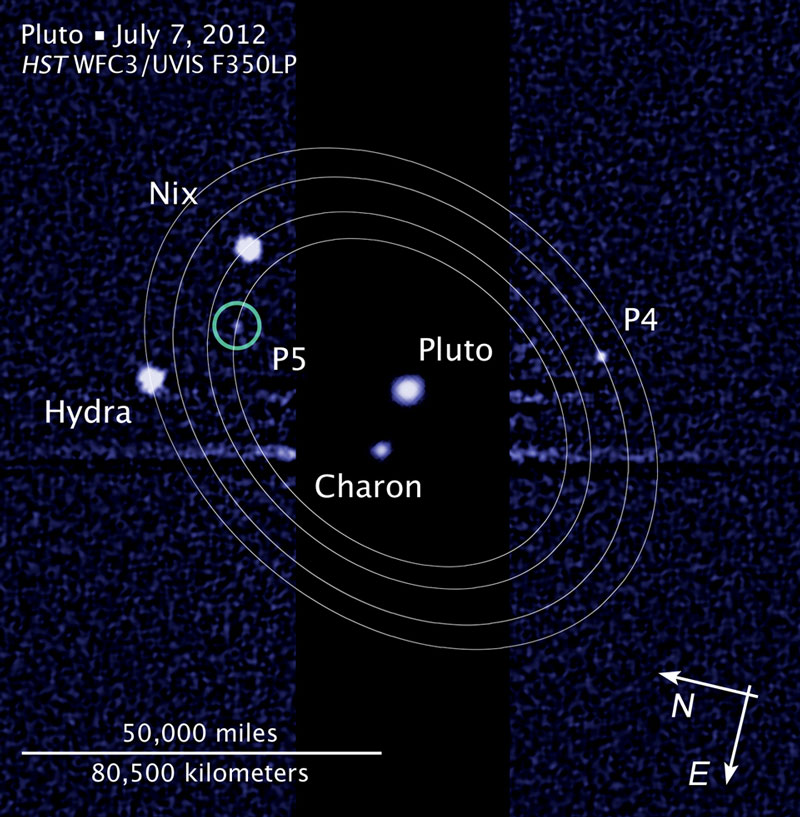
A fifth moon has been discovered orbiting Pluto. The moon was discovered earlier this month in images taken by the Hubble Space Telescope in preparation for the New Horizons mission's scheduled flyby of Pluto in 2015. Pictured above, the moon is currently seen as only a small blip that moves around the dwarf planet as the entire system slowly orbits the Sun. The moon, given a temporary designation of S/2012 (134340) 1 or just P5 (as labeled), is estimated to span about 15 kilometers and is likely composed mostly of water-ice. Pluto remains the only famous Solar System body never visited by a human-built probe and so its origins and detailed appearance remain mostly unknown.