The Sun
The Sun is a yellow dwarf star (G2V), about 4.6 billion years old, and the dominant gravitational force in the Solar System. It has a diameter of roughly 1.4 million kilometers and contains around 99.8% of the Solar System’s mass. Nuclear fusion in its core converts hydrogen into helium, producing energy that warms the planets. Above the core lie the radiative and convective zones, followed by the visible photosphere (~5,500 °C), the chromosphere, and the much hotter corona (~2 million °C).
Source: science.nasa.gov
APODs including "The Sun"
South Pole Star Trails
02/08/2012
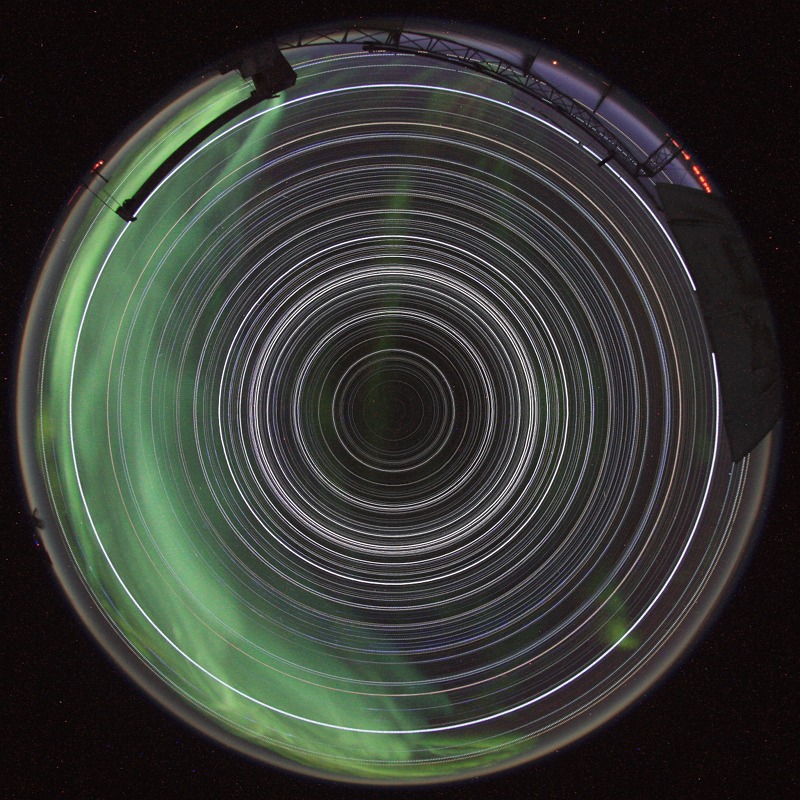
No star dips below the horizon and the Sun never climbs above it in this remarkable image of 24 hour long star trails. Showing all the trails as complete circles, such an image could be achieved only from two places on planet Earth. This example was recorded during the course of May 1, 2012, the digital camera in a heated box on the roof of MAPO, the Martin A. Pomerantz Observatory at the South Pole. Directly overhead in the faint constellation Octans is the projection of Earth's rotational axis, the South Celestial Pole, at the center of all the star trail circles. Not so well placed as Polaris and the North Celestial Pole, the star leaving the small but still relatively bright circle around the South Celestial Pole is Beta Hydri. The inverted umbrella structure on the horizon at the right of the allsky field of view is the ground shield for the SPUD telescope. A shimmering apparition of the aurora australis also visited on this 24 hour night.