The Sun
The Sun is a yellow dwarf star (G2V), about 4.6 billion years old, and the dominant gravitational force in the Solar System. It has a diameter of roughly 1.4 million kilometers and contains around 99.8% of the Solar System’s mass. Nuclear fusion in its core converts hydrogen into helium, producing energy that warms the planets. Above the core lie the radiative and convective zones, followed by the visible photosphere (~5,500 °C), the chromosphere, and the much hotter corona (~2 million °C).
Source: science.nasa.gov
APODs including "The Sun"
Bright Jupiter in Taurus
27/11/2012
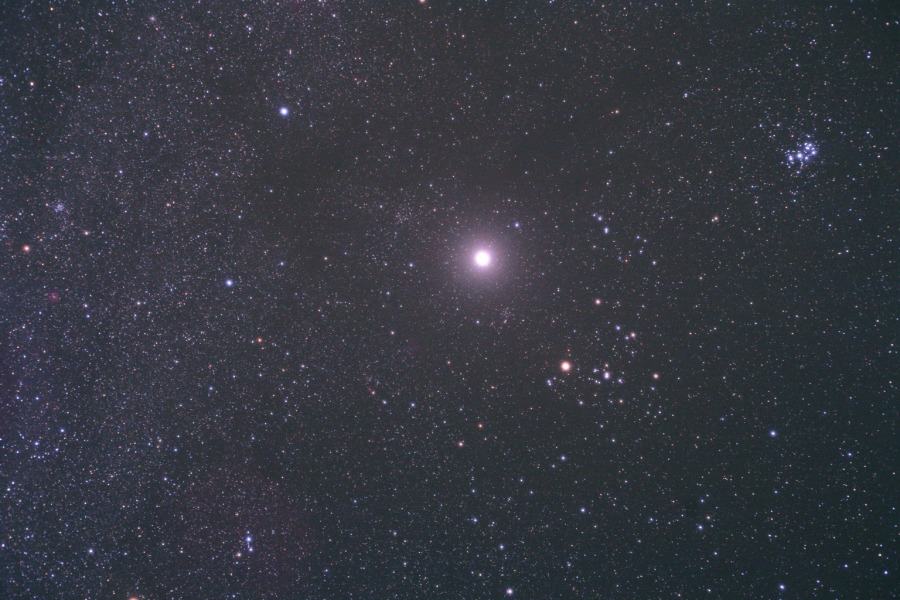
That bright star you've recently noticed rising just after sunset isn't a star at all. It's Jupiter, the solar system's ruling gas giant. Bright Jupiter is nearing its December 3rd opposition when it will stand in Taurus, opposite the Sun in planet Earth's sky. Clearly outshining yellowish Aldebaran, alpha star of Taurus, Jupiter is centered in this skyview from November 14th, also featuring the Pleiades and Hyades star clusters, familiar celestial sights as the northern hemisphere winter approaches. Sliding your cursor over the image will label the scene and identify two other solar system worlds approaching their opposition in December. Small and faint, asteroid Vesta and dwarf planet Ceres are about 10 degrees from Jupiter, near the left edge of the frame. Of course, you can imagine NASA's Dawn spacecraft in this field of view. Having left Vesta in September, Dawn's ion engine is now steadily driving it to match orbits with Ceres, scheduled to arrive there in February 2015.