The Sun
The Sun is a yellow dwarf star (G2V), about 4.6 billion years old, and the dominant gravitational force in the Solar System. It has a diameter of roughly 1.4 million kilometers and contains around 99.8% of the Solar System’s mass. Nuclear fusion in its core converts hydrogen into helium, producing energy that warms the planets. Above the core lie the radiative and convective zones, followed by the visible photosphere (~5,500 °C), the chromosphere, and the much hotter corona (~2 million °C).
Source: science.nasa.gov
APODs including "The Sun"
In the Center of Saturn's North Polar Vortex
04/12/2012
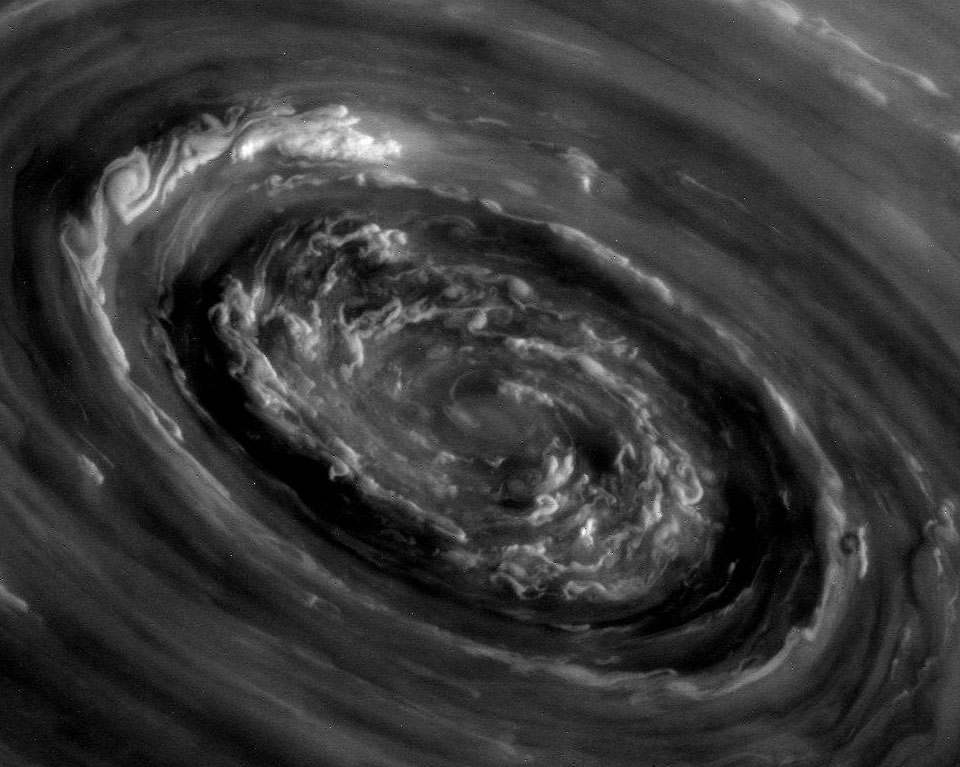
What's happening at the north pole of Saturn? A vortex of strange and complex swirling clouds. The center of this vortex was imaged in unprecedented detail last week by the robotic Cassini spacecraft orbiting Saturn. These clouds lie at the center of the unusual hexagonal cloud system that surrounds the north pole of Saturn. The sun rose on Saturn's north pole just a few years ago, with Cassini taking only infrared images of the shadowed region previously. The above image is raw and unprocessed and is being prepared for release in 2013. Several similar images of the region have recently been condensed into a movie. Planetary scientists are sure to continue to study this most unusual cloud formation for quite some time. Astrophysicists: Code sharing meeting in January