The Sun
The Sun is a yellow dwarf star (G2V), about 4.6 billion years old, and the dominant gravitational force in the Solar System. It has a diameter of roughly 1.4 million kilometers and contains around 99.8% of the Solar System’s mass. Nuclear fusion in its core converts hydrogen into helium, producing energy that warms the planets. Above the core lie the radiative and convective zones, followed by the visible photosphere (~5,500 °C), the chromosphere, and the much hotter corona (~2 million °C).
Source: science.nasa.gov
APODs including "The Sun"
Baku Moonrise
08/12/2012
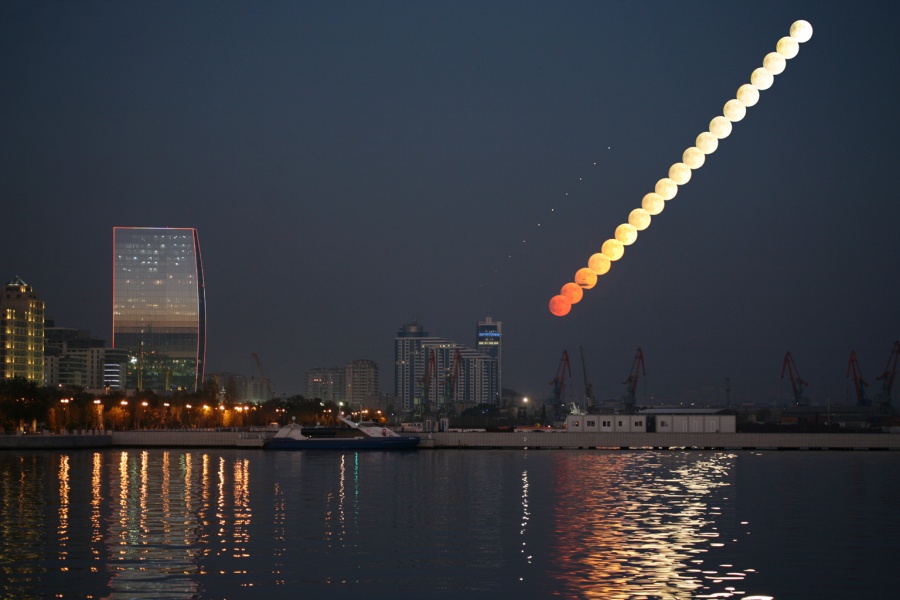
A Full Moon rises in this waterfront scene. Its colorful, watery reflection is joined by harbor lights and a windowed skyscraper's echo of the western horizon just after sunset. The tantalizing image is a composite of frames recorded at 2 minute intervals on November 28 from the Caspian Sea port city of Baku, Azerbaijan. Still, this Full Moon was not really as big or as bright as others, though it might be hard to tell. In fact, November 28's Full Moon was near apogee, making it the smallest Full Moon of 2012. As it rose over the Baku boardwalk (along with much of the eastern hemisphere), it was also in the Earth's lighter or penumbral shadow. The subtle effect of the penumbral lunar eclipse is just discernible as the slightly darker left side of the lunar disk. Opposite the Sun in planet Earth's sky, the Full Moon was also joined by bright planet Jupiter, only a few days from its own opposition.