The Sun
The Sun is a yellow dwarf star (G2V), about 4.6 billion years old, and the dominant gravitational force in the Solar System. It has a diameter of roughly 1.4 million kilometers and contains around 99.8% of the Solar System’s mass. Nuclear fusion in its core converts hydrogen into helium, producing energy that warms the planets. Above the core lie the radiative and convective zones, followed by the visible photosphere (~5,500 °C), the chromosphere, and the much hotter corona (~2 million °C).
Source: science.nasa.gov
APODs including "The Sun"
Yosemite Winter Night
25/12/2012
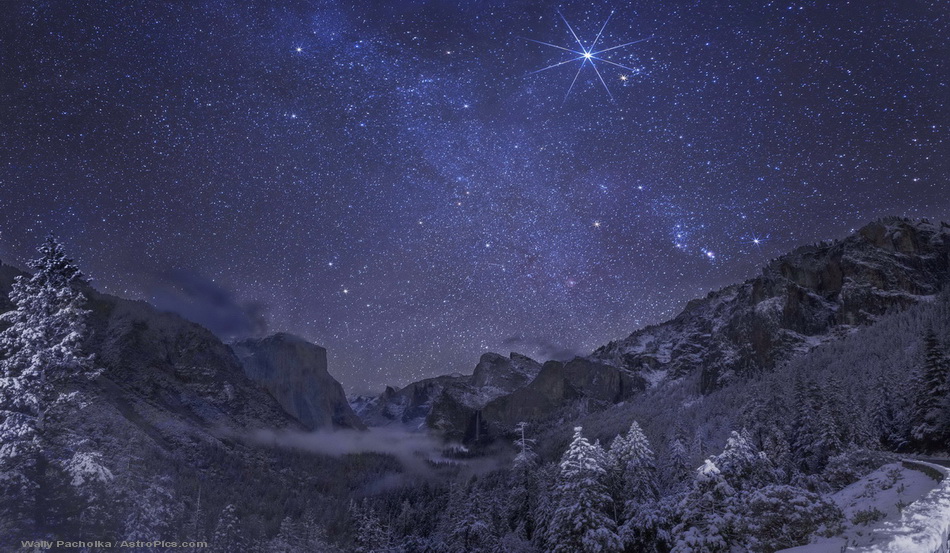
In this evocative night skyscape a starry band of the Milky Way climbs over Yosemite Valley, Sierra Nevada Range, planet Earth. Jupiter is the brightest celestial beacon on the wintry scene, though. Standing nearly opposite the Sun in the constellation Taurus, the wandering planet joins yellowish Aldebaran and the Hyades star cluster. Below, Orion always comes up sideways over a fence of mountains. And from there the twin stars of Gemini rise just across the Milky Way. As this peaceful winter night began, they followed Auriga the charioteer, its alpha star Capella near the top of the frame.