The Sun
The Sun is a yellow dwarf star (G2V), about 4.6 billion years old, and the dominant gravitational force in the Solar System. It has a diameter of roughly 1.4 million kilometers and contains around 99.8% of the Solar System’s mass. Nuclear fusion in its core converts hydrogen into helium, producing energy that warms the planets. Above the core lie the radiative and convective zones, followed by the visible photosphere (~5,500 °C), the chromosphere, and the much hotter corona (~2 million °C).
Source: science.nasa.gov
APODs including "The Sun"
Mars: Shadow at Point Lake
05/02/2013
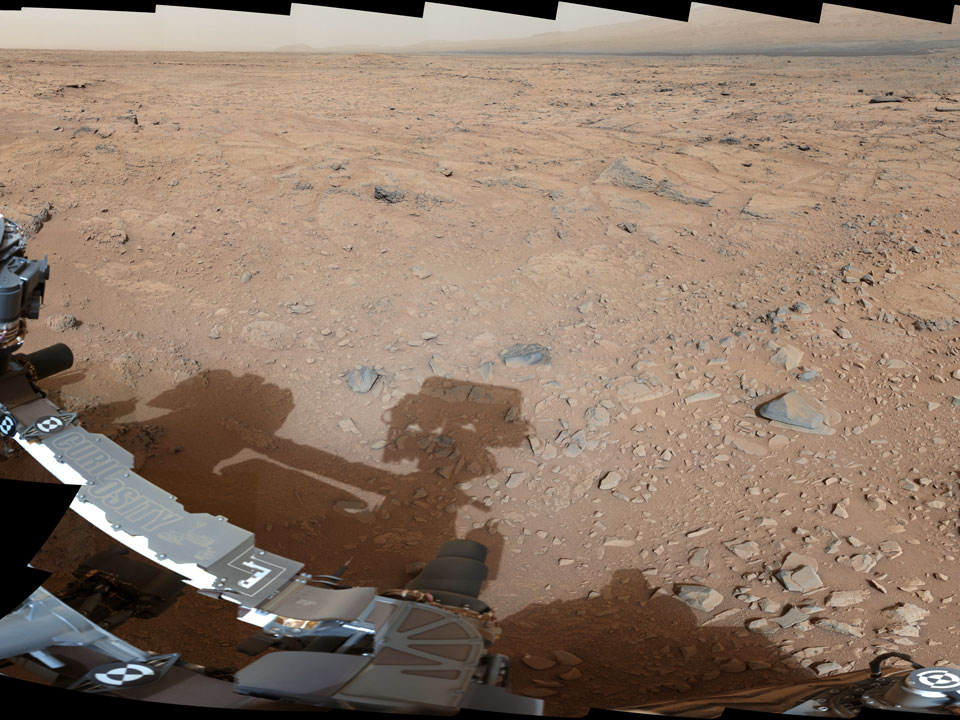
What if you saw your shadow on Mars and it wasn't human? Then you might be the robotic Curiosity rover currently exploring Mars. Curiosity landed in Gale Crater last August and has been busy looking for signs of ancient running water and clues that Mars could once have harbored life. Pictured above, Curiosity has taken a wide panorama that includes its own shadow in the direction opposite the Sun. The image was taken in November from a location dubbed Point Lake, although no water presently exists there. Curiosity has already discovered several indications of dried streambeds on Mars, and is scheduled to continue its exploration by climbing nearby Mt. Sharp over the next few years.