The Sun
The Sun is a yellow dwarf star (G2V), about 4.6 billion years old, and the dominant gravitational force in the Solar System. It has a diameter of roughly 1.4 million kilometers and contains around 99.8% of the Solar System’s mass. Nuclear fusion in its core converts hydrogen into helium, producing energy that warms the planets. Above the core lie the radiative and convective zones, followed by the visible photosphere (~5,500 °C), the chromosphere, and the much hotter corona (~2 million °C).
Source: science.nasa.gov
APODs including "The Sun"
Clouds, Comet and Crescent Moon
14/03/2013
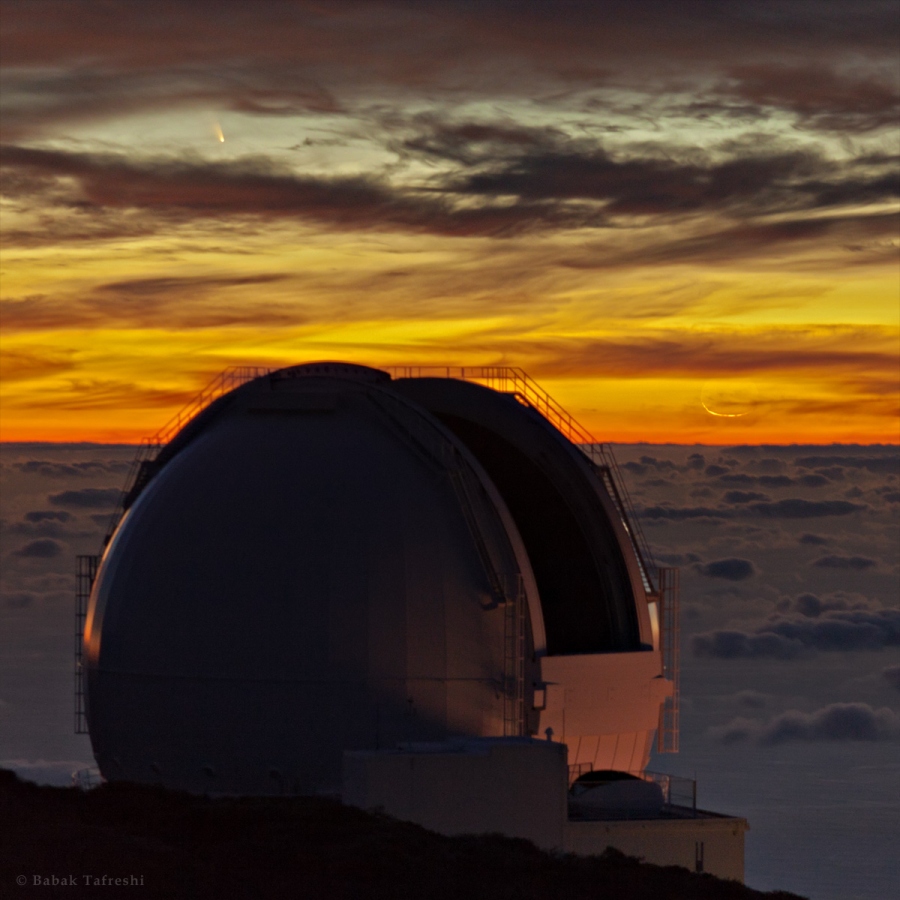
In silhouette against the colorful evening twilight, clouds part for this much anticipated magic moment. The scene captures naked-eye Comet PanSTARRS peeking into northern hemisphere skies on March 12. The comet stands over the western horizon after sunset, joined by the thin, flattened crescent of a day old Moon. Posing for its own beauty shot, the subtly lit dome of the 4.2 meter William Herschel Telescope is perched above cloud banks on the Canary Island of La Palma. While PanSTARRS has not quite developed into the spectacular comet once hoped for, it is still growing easier to see in the north. In coming days it will steadily climb north, farther from the Sun into darker western evening skies. Growing Gallery: Comet PanSTARRS at Sunset