The Sun
The Sun is a yellow dwarf star (G2V), about 4.6 billion years old, and the dominant gravitational force in the Solar System. It has a diameter of roughly 1.4 million kilometers and contains around 99.8% of the Solar System’s mass. Nuclear fusion in its core converts hydrogen into helium, producing energy that warms the planets. Above the core lie the radiative and convective zones, followed by the visible photosphere (~5,500 °C), the chromosphere, and the much hotter corona (~2 million °C).
Source: science.nasa.gov
APODs including "The Sun"
Comet Castle
22/03/2013
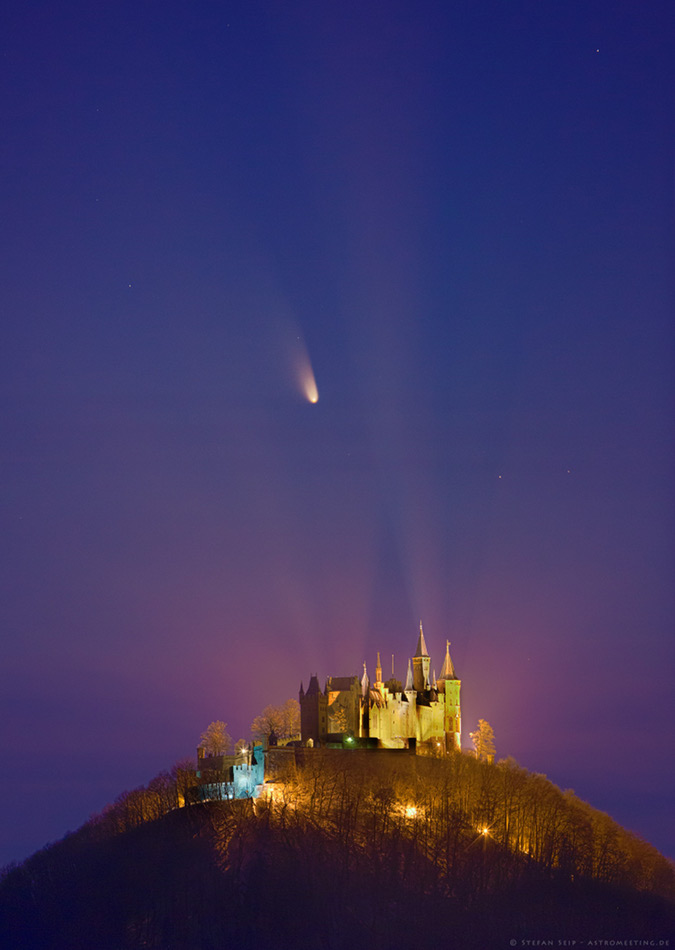
The broad dust tail of Comet PanSTARRS (C/2011 L4) has become a familiar sight for many northern hemisphere comet watchers, as the comet fades but rises higher above the western horizon after sunset. This view of the popular comet may seem a little fantastic, though. Sweeping away from the Sun and trailing behind the comet's orbit, the curving dust tail also seems to stream away from a shining mountaintop castle. Comet Castle might be an appropriate name in this scene, but its traditional name is Castle Hohenzollern. Taken on March 15 with an extreme telephoto lens, the Comet Castle image was captured in exceptionally clear skies about 80 kilometers away from Stuttgart, Germany. Gallery: Comet PanSTARRS