The Sun
The Sun is a yellow dwarf star (G2V), about 4.6 billion years old, and the dominant gravitational force in the Solar System. It has a diameter of roughly 1.4 million kilometers and contains around 99.8% of the Solar System’s mass. Nuclear fusion in its core converts hydrogen into helium, producing energy that warms the planets. Above the core lie the radiative and convective zones, followed by the visible photosphere (~5,500 °C), the chromosphere, and the much hotter corona (~2 million °C).
Source: science.nasa.gov
APODs including "The Sun"
Comet PANSTARRS and the Andromeda Galaxy
03/04/2013
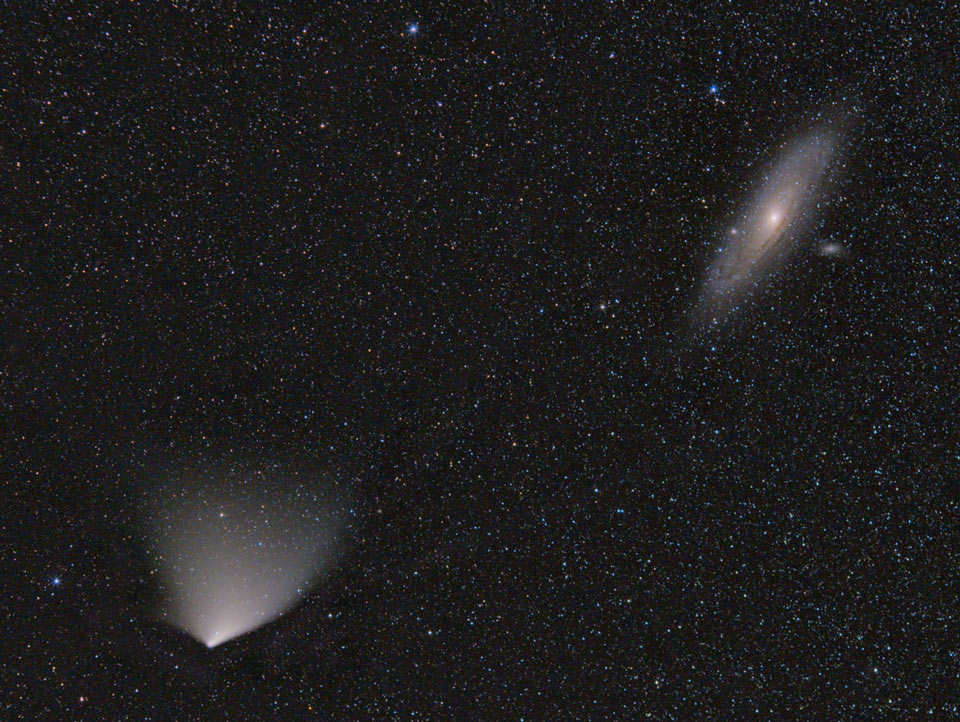
Currently, comet PANSTARRS is passing nearly in front of the galaxy Andromeda. Coincidentally, both comet and galaxy appear now to be just about the same angular size. In physical size, even though Comet PANSTARRS is currently the largest object in the Solar System with a tail spanning about 15 times the diameter of the Sun, it is still about 70 billion times smaller than the Andromeda galaxy (M31). The above image was captured on March 30, near Syktyvkar, Russia. As C/2011 L4 (PANSTARRS) on the lower left recedes from the Sun and dims, it is returning to the northerly direction whence it came. When the comet will return is currently unknown, although humans may have merged with computers by then. Gallery: Comet PANSTARRS