The Sun
The Sun is a yellow dwarf star (G2V), about 4.6 billion years old, and the dominant gravitational force in the Solar System. It has a diameter of roughly 1.4 million kilometers and contains around 99.8% of the Solar System’s mass. Nuclear fusion in its core converts hydrogen into helium, producing energy that warms the planets. Above the core lie the radiative and convective zones, followed by the visible photosphere (~5,500 °C), the chromosphere, and the much hotter corona (~2 million °C).
Source: science.nasa.gov
APODs including "The Sun"
Hungarian Spring Eclipse
04/05/2013
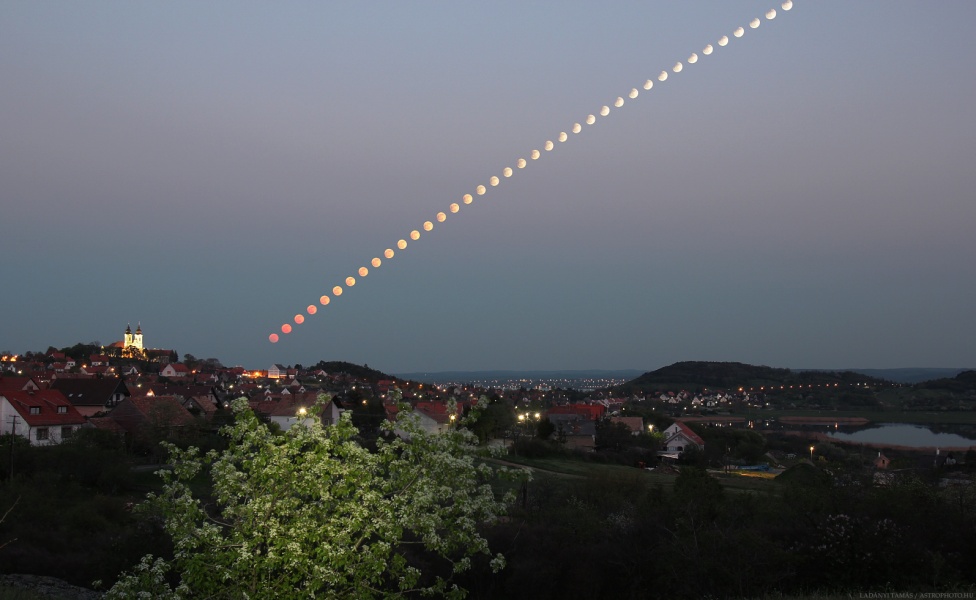
Last week, as the Sun set a Full Moon rose over the springtime landscape of Tihany, Hungary on the northern shores of Lake Balaton. As it climbed into the clear sky, the Moon just grazed the dark, umbral shadow of planet Earth in the year's first partial lunar eclipse. The partial phase, seen near the top of this frame where the lunar disk is darkened along the upper limb, lasted for less than 27 minutes. Composited from consecutive exposures, the picture presents the scene's range of natural colors and subtle shading apparent to the eye. At next week's New Moon, the season's celestial shadow play will continue with an annular solar eclipse, the path of annularity tracking through northern Australia and the central Pacific.