The Sun
The Sun is a yellow dwarf star (G2V), about 4.6 billion years old, and the dominant gravitational force in the Solar System. It has a diameter of roughly 1.4 million kilometers and contains around 99.8% of the Solar System’s mass. Nuclear fusion in its core converts hydrogen into helium, producing energy that warms the planets. Above the core lie the radiative and convective zones, followed by the visible photosphere (~5,500 °C), the chromosphere, and the much hotter corona (~2 million °C).
Source: science.nasa.gov
APODs including "The Sun"
Blue Sun Bursting
20/05/2013
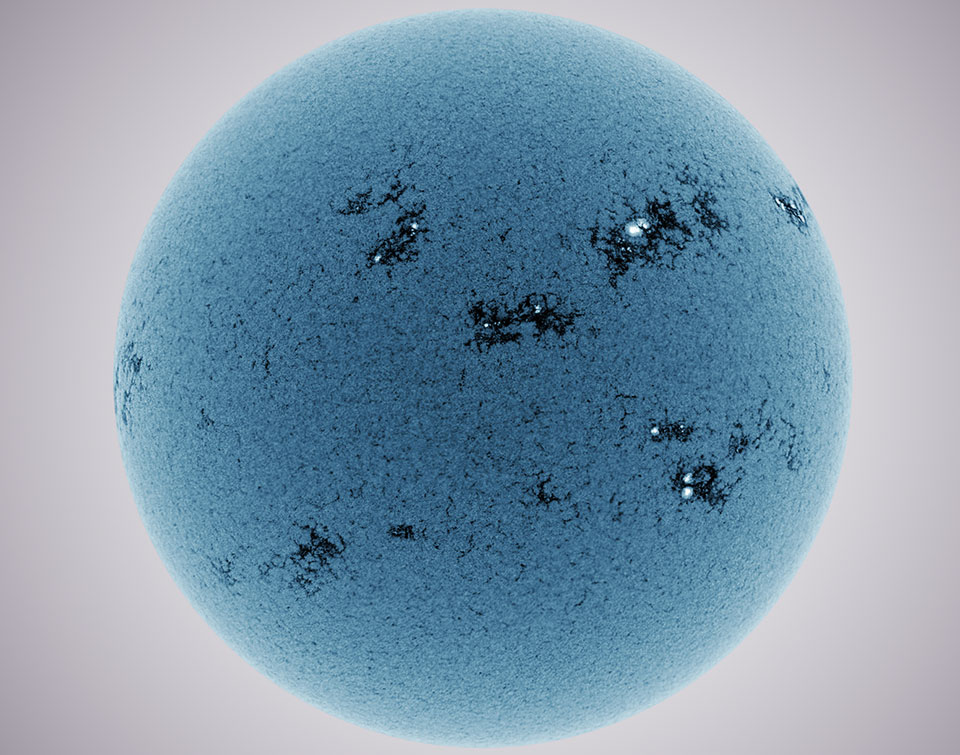
Our Sun is not a giant blueberry. Our Sun can be made to appear similar to the diminutive fruit, however, by imaging it in a specific color of extreme violet light called CaK that is emitted by the very slight abundance of ionized Calcium in the Sun's atmosphere, and then false color-inverting the image. This solar depiction is actually scientifically illuminating as a level of the Sun's chromosphere appears quite prominent, showing a crackly textured surface, cool sunspots appearing distinctly bright, and surrounding hot active regions appearing distinctly dark. The Sun is currently near the maximum activity level in its 11 year cycle, and has emitted powerful flares over the past week. During times of high activity, streams of energetic particles from Sun may impact the Earth's magnetosphere and set off spectacular auroras.