The Sun
The Sun is a yellow dwarf star (G2V), about 4.6 billion years old, and the dominant gravitational force in the Solar System. It has a diameter of roughly 1.4 million kilometers and contains around 99.8% of the Solar System’s mass. Nuclear fusion in its core converts hydrogen into helium, producing energy that warms the planets. Above the core lie the radiative and convective zones, followed by the visible photosphere (~5,500 °C), the chromosphere, and the much hotter corona (~2 million °C).
Source: science.nasa.gov
APODs including "The Sun"
Bird Sun Dog
27/05/2013
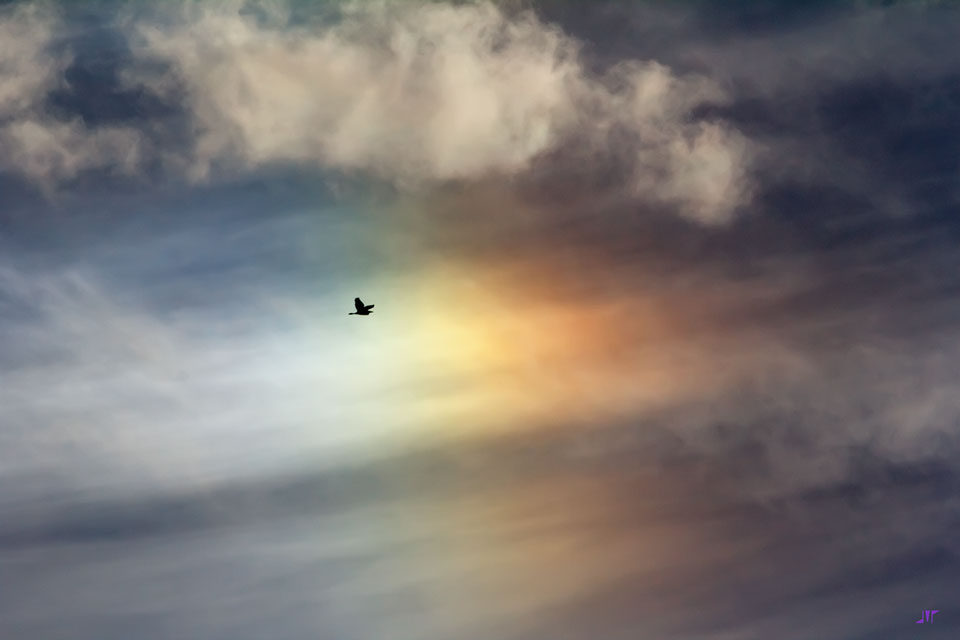
Have you ever seen a little rainbow off to the side of the Sun? Rare but rewarding to see, such spectacles are known as sundogs, mock suns or parhelia. Sundogs are just sunlight refracting through hexagonal falling ice crystals in the Earth's atmosphere. When thin ice crystals flitter down nearly horizontally, they best refract sunlight sideways and create sundogs. Alternatively, randomly oriented ice crystals may create a complete circular sun halo. Sundogs occur 22 degrees to each side of a setting or rising Sun, although sometimes nearby clouds can block one or both. The above image was taken through a polarizing filter during October 2012 in M�rida, Spain.