The Sun
The Sun is a yellow dwarf star (G2V), about 4.6 billion years old, and the dominant gravitational force in the Solar System. It has a diameter of roughly 1.4 million kilometers and contains around 99.8% of the Solar System’s mass. Nuclear fusion in its core converts hydrogen into helium, producing energy that warms the planets. Above the core lie the radiative and convective zones, followed by the visible photosphere (~5,500 °C), the chromosphere, and the much hotter corona (~2 million °C).
Source: science.nasa.gov
APODs including "The Sun"
A Super Moon's Halo
28/06/2013
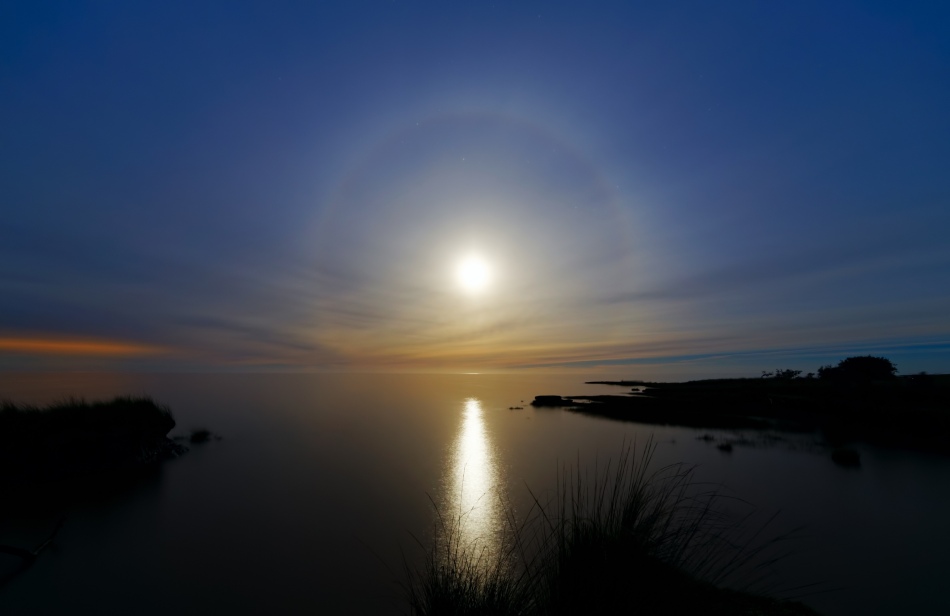
A Full Perigee Moon rose as the Sun set last Sunday. At its closest to Earth it was, by just a bit, the year's brightest and largest Full Moon also known as a Super Moon. Seen from Punta Piedras, Argentina and the mouth of the Rio de La Plata, near Buenos Aires, the Super Moon's light created this magnificent circular lunar halo. Still, the size of a lunar halo is determined by the geometry of six sided water ice crystals in planet Earth's high, thin clouds. The crystals deflect the rays of moonlight more strongly through a minimum angle of 22 degrees. So this halo has an inner radius of 22 degrees, just like the halos of the less-than-super moons. Even more common than a Super Moon, beautiful 22 degree halos can be spotted at any time of year.