The Sun
The Sun is a yellow dwarf star (G2V), about 4.6 billion years old, and the dominant gravitational force in the Solar System. It has a diameter of roughly 1.4 million kilometers and contains around 99.8% of the Solar System’s mass. Nuclear fusion in its core converts hydrogen into helium, producing energy that warms the planets. Above the core lie the radiative and convective zones, followed by the visible photosphere (~5,500 °C), the chromosphere, and the much hotter corona (~2 million °C).
Source: science.nasa.gov
APODs including "The Sun"
PanSTARRS: The Anti Tail Comet
29/06/2013
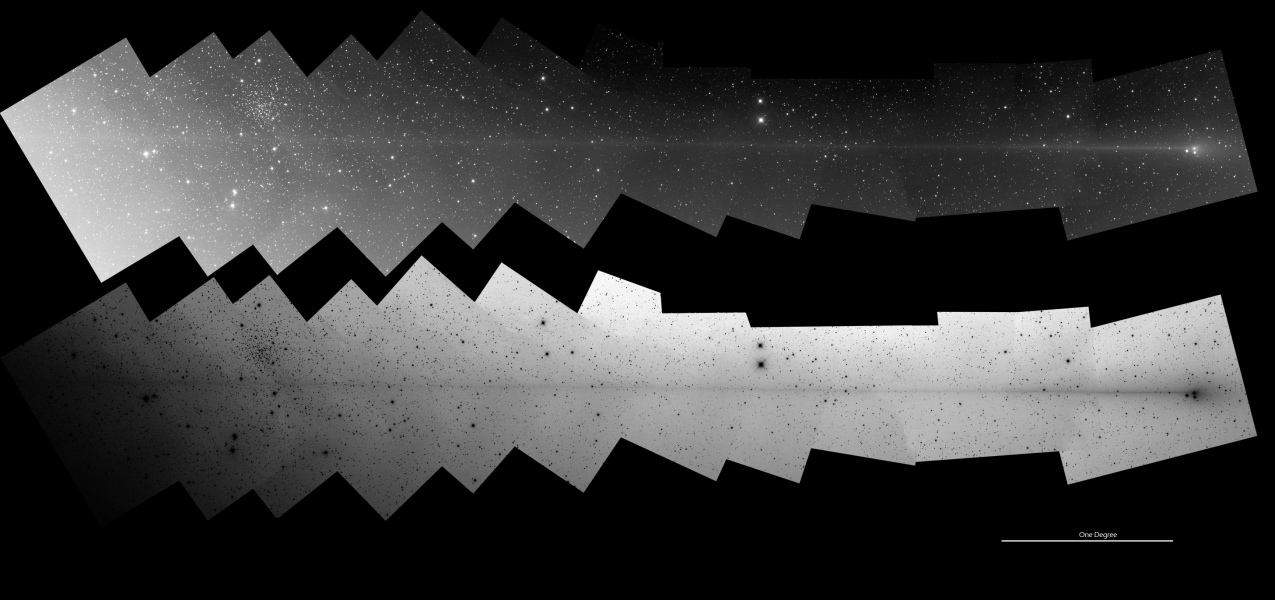
Once known as Earth's sunset comet, PanSTARRS (C/2011 L4) is up all night now, but only for northern hemisphere skygazers. Telescopes are required to track its progress as it fades and heads for the outer solar system. But because planet Earth passed through the comet's orbital plane in late May, PanSTARRS will also be remembered for its remarkably long anti-tail. That edge-on perspective looking along the broad, fanned-out dust tail as it trailed behind the comet created the appearance of an anti-tail pointing in the sunward direction, back toward the inner solar system. Recorded on the night of May 27, this 13 pane mosaic (shown in positive and negative views) follows PanSTARRS' anti-tail as it stretches over 7 degrees from the comet's coma at the far right. The anti-tail was likely much longer, but gets lost in the evening's bright moonlight encroaching on the left edge of the scene. Background star cluster NGC 188 in Cepheus shows up along the way, near top left.