The Sun
The Sun is a yellow dwarf star (G2V), about 4.6 billion years old, and the dominant gravitational force in the Solar System. It has a diameter of roughly 1.4 million kilometers and contains around 99.8% of the Solar System’s mass. Nuclear fusion in its core converts hydrogen into helium, producing energy that warms the planets. Above the core lie the radiative and convective zones, followed by the visible photosphere (~5,500 °C), the chromosphere, and the much hotter corona (~2 million °C).
Source: science.nasa.gov
APODs including "The Sun"
Comet Lemmon and the Deep Sky
20/07/2013
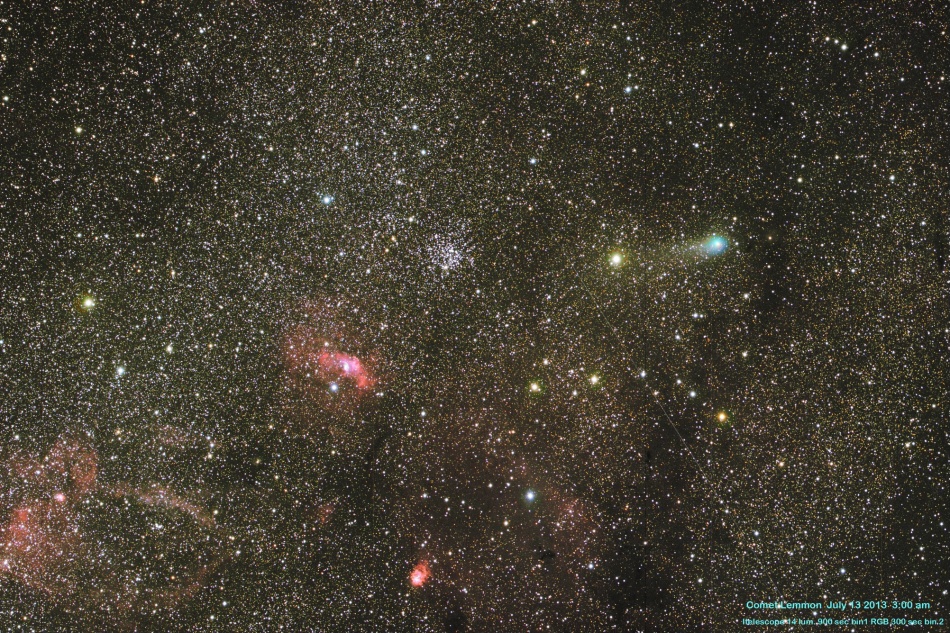
Now sweeping high above the ecliptic plane, Comet Lemmon has faded dramatically in planet Earth's night sky as it heads for the outer solar system. Some 16 light-minutes (2 AU) from the Sun, it still sports a greenish coma though, posing on the right in this 4 degree wide telescopic view from last Saturday with deep sky star clusters and nebulae in Cassiopeia. In fact, the rich background skyscape is typical within the boundaries of the boastful northern constellation that lie along the crowded starfields of the Milky Way. Included near center is open star cluster M52 about 5,000 light-years away. Around 11,000 light-years distant, the red glowing nebula NGC 7635 below and left of M52 is well-known for its appearance in close-up images as the Bubble Nebula. But the fading Comet Lemmon is not the only foreground object on the scene. A faint streak on the right is an orbiting satellite caught crossing through the field during the long exposure, glinting in the sunlight and winking out as it passes into Earth's shadow. Interplanetary News: Photo Op from Cassini and MESSENGER - just be sure to smile and wave.