The Sun
The Sun is a yellow dwarf star (G2V), about 4.6 billion years old, and the dominant gravitational force in the Solar System. It has a diameter of roughly 1.4 million kilometers and contains around 99.8% of the Solar System’s mass. Nuclear fusion in its core converts hydrogen into helium, producing energy that warms the planets. Above the core lie the radiative and convective zones, followed by the visible photosphere (~5,500 °C), the chromosphere, and the much hotter corona (~2 million °C).
Source: science.nasa.gov
APODs including "The Sun"
M31 versus M33
26/09/2013
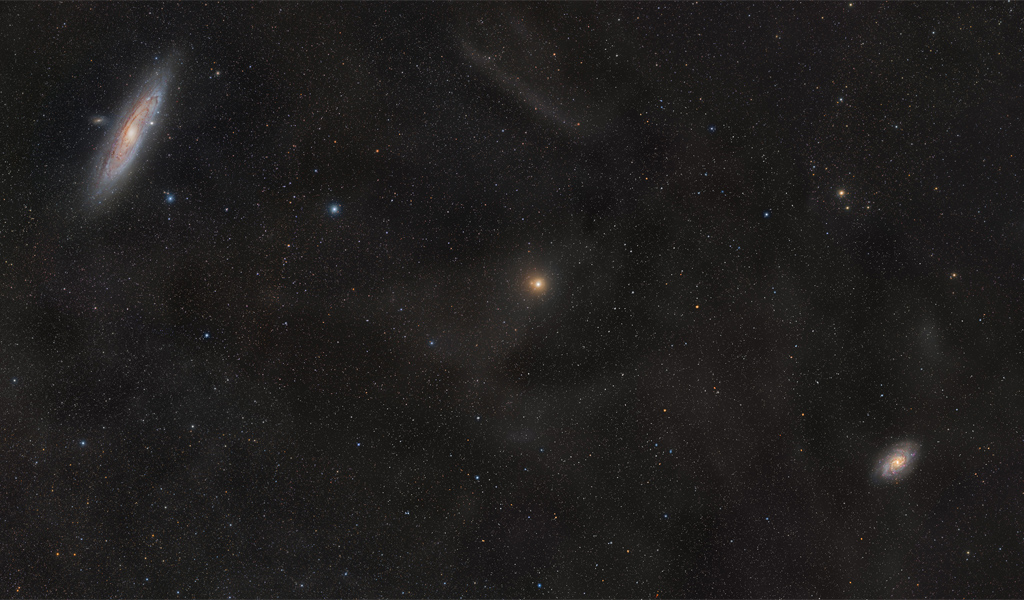
Separated by about 14 degrees (28 Full Moons) in planet Earth's sky, spiral galaxies M31, left, and M33 are both large members of the Local Group, along with our own Milky Way galaxy. This wide-angle, telescopic mosaic captures colorful details of spiral structure in both, while the massive neighboring galaxies seem to be balanced either side of bright Mirach, beta star in the constellation Andromeda. But M31, the Andromeda Galaxy, is really 2.5 million light-years distant and M33, the Triangulum Galaxy, is also about 3 million light years away. Mirach, just 200 light-years from the Sun, lies well within the Milky Way, along with the dim clouds of dust drifting through the frame only a few hundred light-years above the galactic plane. Although they look far apart, M31 and M33 are locked in a mutual gravitational embrace. Radio astronomers have found indications of a bridge of neutral hydrogen gas that could connect the two, evidence of a closer encounter in the past. Based on measurements, gravitational simulations currently predict that the Milky Way, M31, and M33 will all undergo mutual close encounters and potentially mergers, billions of years in the future.