The Sun
The Sun is a yellow dwarf star (G2V), about 4.6 billion years old, and the dominant gravitational force in the Solar System. It has a diameter of roughly 1.4 million kilometers and contains around 99.8% of the Solar System’s mass. Nuclear fusion in its core converts hydrogen into helium, producing energy that warms the planets. Above the core lie the radiative and convective zones, followed by the visible photosphere (~5,500 °C), the chromosphere, and the much hotter corona (~2 million °C).
Source: science.nasa.gov
APODs including "The Sun"
The Great Comet of 1680 Over Rotterdam
28/10/2013
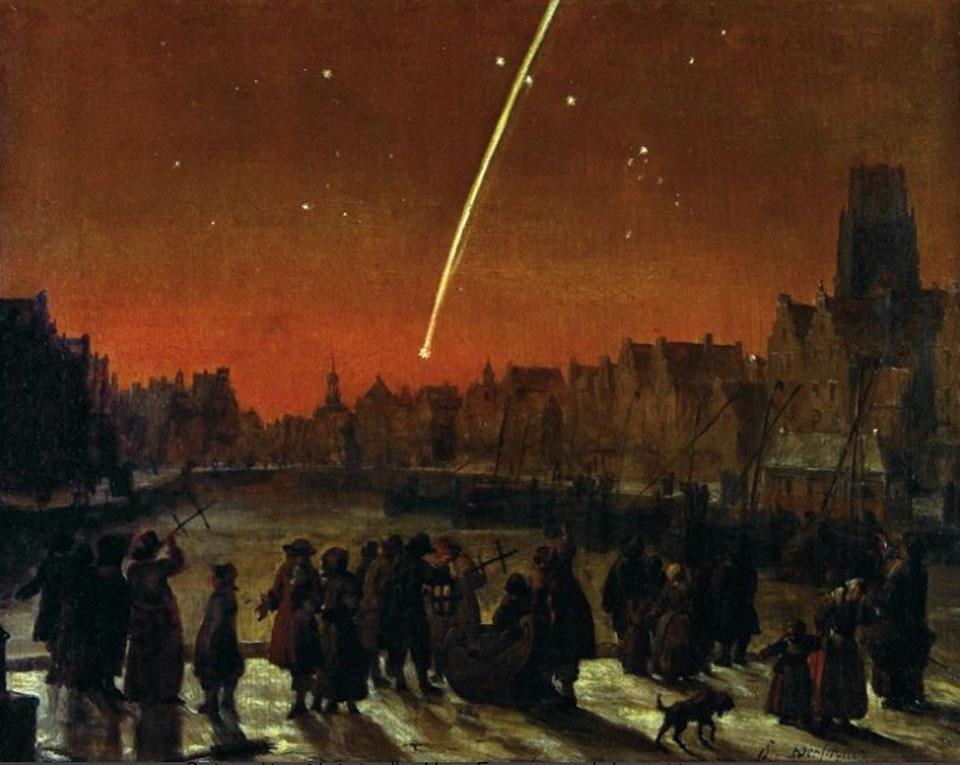
Was there ever another comet like ISON? Although no two comets are exactly alike, one that appears to have had notable similarities was Comet Kirch, the Great Comet of 1680. Like approaching Comet ISON, Comet Kirch was a bright sungrazer, making a very close approach to the surface of the Sun. Neither comet, coincidently, is a member of the most common group of sungrazers -- the Kreutz group -- populated by remnants of a comet that disintegrated near the Sun hundreds of years ago. The long tail of Comet Kirch is depicted in the above painting by Lieve Versheier. As pictured, some members of the foreground crowd of Rotterdam in the Netherlands are holding cross-staffs, an angle measuring device that predated the sextant. No one knows how Comet ISON will develop, but like Comet Kirch, it is expected to be brightest when very near the Sun, in ISON's case during last few days of November. Gallery: Bright Comets of 2013