The Sun
The Sun is a yellow dwarf star (G2V), about 4.6 billion years old, and the dominant gravitational force in the Solar System. It has a diameter of roughly 1.4 million kilometers and contains around 99.8% of the Solar System’s mass. Nuclear fusion in its core converts hydrogen into helium, producing energy that warms the planets. Above the core lie the radiative and convective zones, followed by the visible photosphere (~5,500 °C), the chromosphere, and the much hotter corona (~2 million °C).
Source: science.nasa.gov
APODs including "The Sun"
Creature Aurora Over Norway
06/11/2013
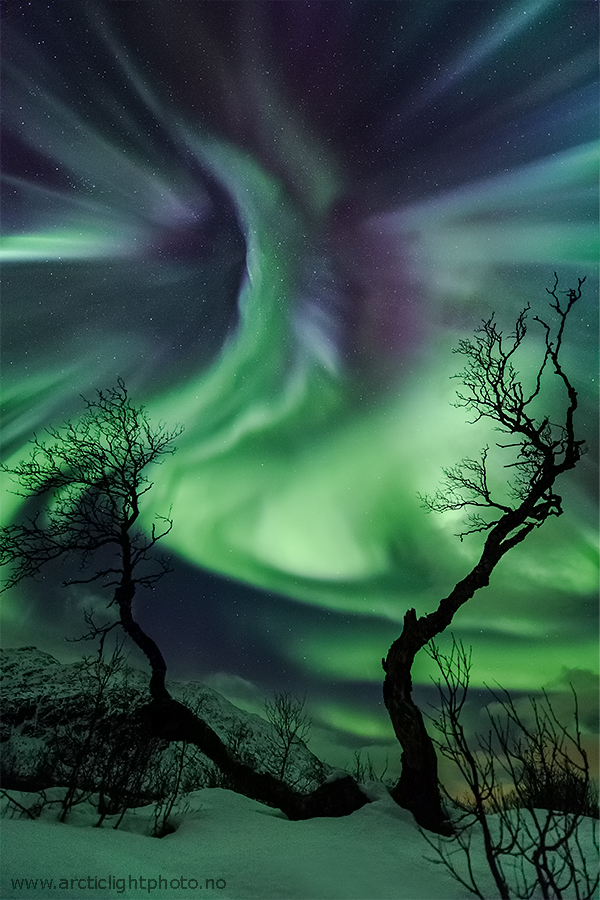
It was Halloween and the sky looked like a creature. Exactly which creature, the astrophotographer was unsure (but possibly you can suggest one). Exactly what caused the eerie apparition was sure: one of the best auroral displays in recent memory. This spectacular aurora had an unusually high degree of detail. Pictured above, the vivid green and purple auroral colors are caused by high atmospheric oxygen and nitrogen reacting to a burst of incoming electrons. Birch trees in Troms�, Norway formed an also eerie foreground. Many other photogenic auroras have been triggered by recent energetic flares on the Sun. Astrophysicists: Browse 600+ codes in the Astrophysics Source Code Library