The Sun
The Sun is a yellow dwarf star (G2V), about 4.6 billion years old, and the dominant gravitational force in the Solar System. It has a diameter of roughly 1.4 million kilometers and contains around 99.8% of the Solar System’s mass. Nuclear fusion in its core converts hydrogen into helium, producing energy that warms the planets. Above the core lie the radiative and convective zones, followed by the visible photosphere (~5,500 °C), the chromosphere, and the much hotter corona (~2 million °C).
Source: science.nasa.gov
APODs including "The Sun"
Comet Lovejoy with M44
09/11/2013
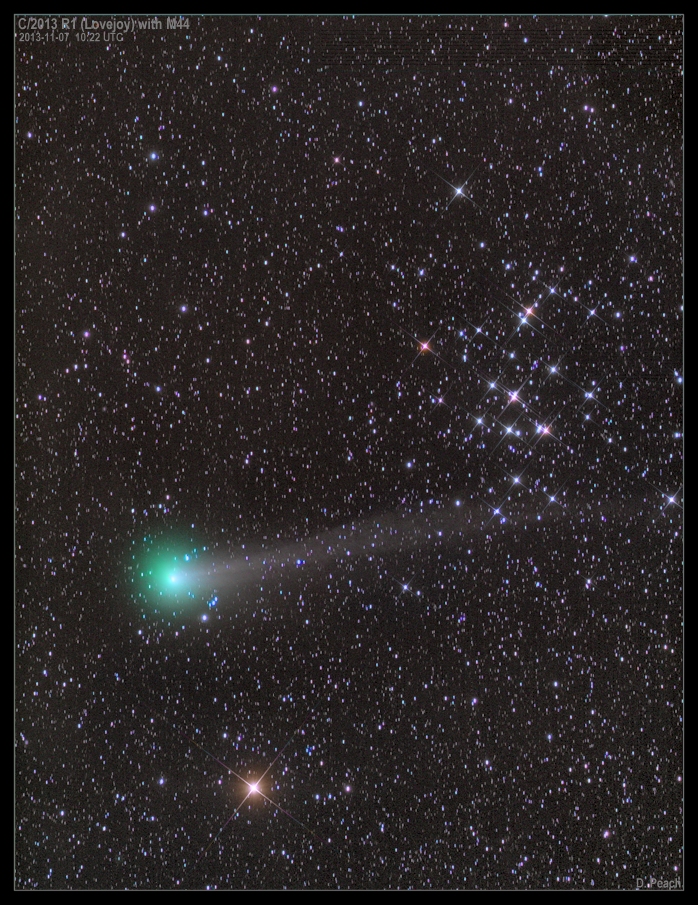
While anxiously waiting for Comet ISON to brighten further as it falls toward the Sun, northern skygazers can also find three other bright comets in the east before dawn. In fact, Comet Lovejoy C/2013 R1 is currently the morning sky's brightest. Only discovered in September and not a sungrazing comet, this Comet Lovejoy is nearing the edge of naked-eye visibility and might be spotted from very dark sky sites. Sporting a greenish coma and tail in this telescopic view taken on November 7, Comet Lovejoy is about 0.5 AU from our fair planet and 1.2 AU from the Sun. The comet is having a photogenic Messier moment, sweeping past well known star cluster M44, the Beehive in Cancer. Yellowish bright star Delta Cancri is near the bottom of the frame.