The Sun
The Sun is a yellow dwarf star (G2V), about 4.6 billion years old, and the dominant gravitational force in the Solar System. It has a diameter of roughly 1.4 million kilometers and contains around 99.8% of the Solar System’s mass. Nuclear fusion in its core converts hydrogen into helium, producing energy that warms the planets. Above the core lie the radiative and convective zones, followed by the visible photosphere (~5,500 °C), the chromosphere, and the much hotter corona (~2 million °C).
Source: science.nasa.gov
APODs including "The Sun"
The Flash Spectrum of the Sun
15/11/2013
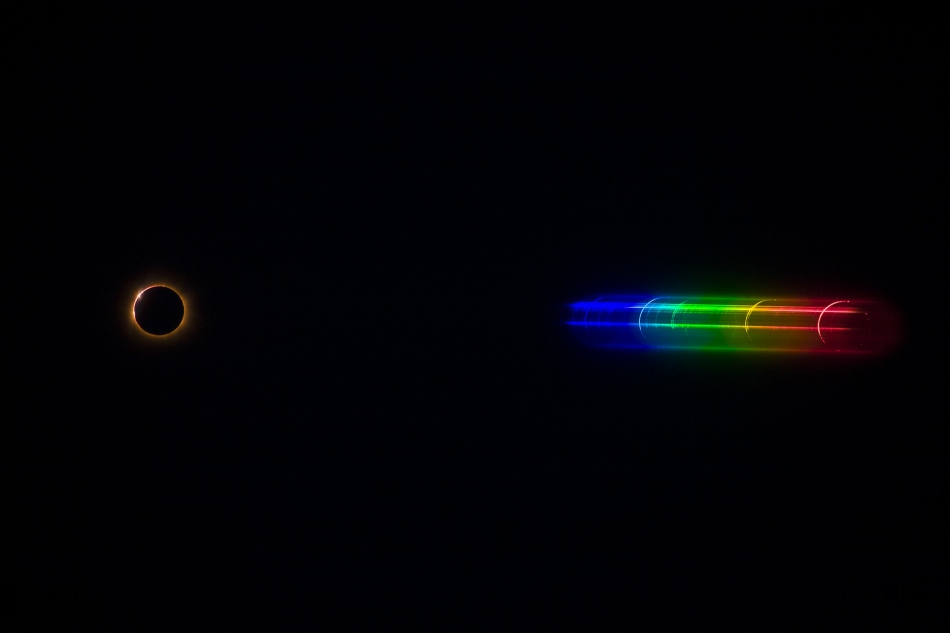
In a flash, the visible spectrum of the Sun changed from absorption to emission on November 3rd, during the brief total phase of a solar eclipse. That fleeting moment is captured by telephoto lens and diffraction grating in this well-timed image from clearing skies over Gabon in equatorial Africa. With overwhelming light from the Sun's disk blocked by the Moon, the normally dominant absorption spectrum of the solar photosphere is hidden. What remains, spread by the diffraction grating into the spectrum of colors to the right of the eclipsed Sun, are individual eclipse images at each wavelength of light emitted by atoms along the thin arc of the solar chromosphere. The brightest images, or strongest chromospheric emission lines, are due to Hydrogen atoms that produce the red hydrogen alpha emission at the far right and blue hydrogen beta emission to the left. In between, the bright yellow emission image is caused by atoms of Helium, an element only first discovered in the flash spectrum of the Sun.