The Sun
The Sun is a yellow dwarf star (G2V), about 4.6 billion years old, and the dominant gravitational force in the Solar System. It has a diameter of roughly 1.4 million kilometers and contains around 99.8% of the Solar System’s mass. Nuclear fusion in its core converts hydrogen into helium, producing energy that warms the planets. Above the core lie the radiative and convective zones, followed by the visible photosphere (~5,500 °C), the chromosphere, and the much hotter corona (~2 million °C).
Source: science.nasa.gov
APODs including "The Sun"
Active Comet ISON
16/11/2013
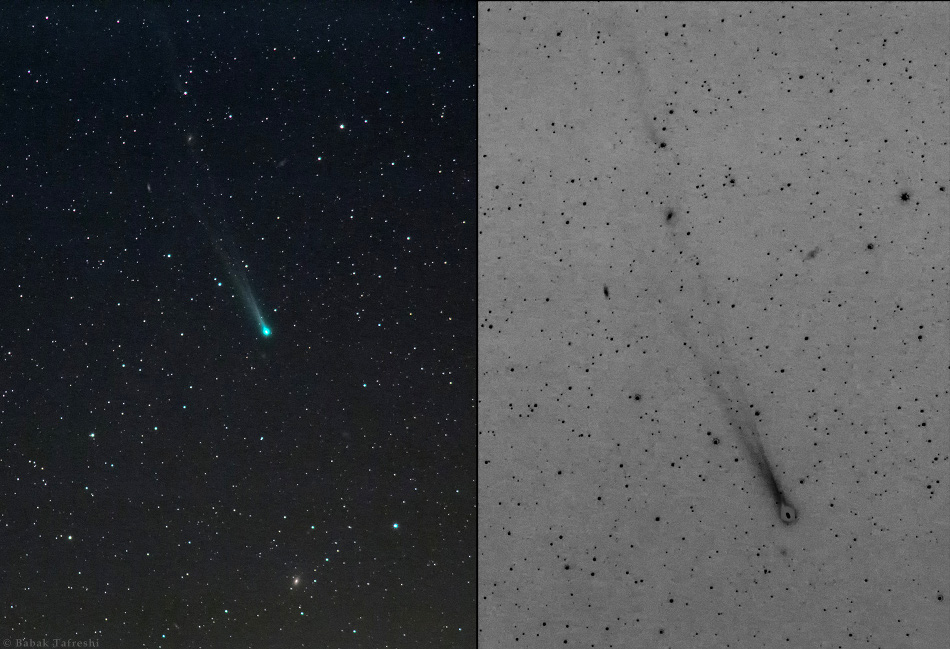
Falling through planet Earth's predawn skies toward its close encounter with the Sun on November 28, Comet ISON is coming to life. The much anticipated comet has now been reported to have substantially increased in activity, surging to naked-eye visibility for dark sites and sprouting a more complex tail. ISON's tail stretches over two degrees in this telephoto skyview from southern Kenya, captured on the morning of November 14. Shown in two panels, the enlarged negative version on the right makes details of the long tail easier to trace, including the tail's separated filaments toward the top of the frame. A sungrazer and first time visitor to the inner solar system, the possibility of ISON's survival to become a bright comet in planet Earth's December skies remains a question.