The Sun
The Sun is a yellow dwarf star (G2V), about 4.6 billion years old, and the dominant gravitational force in the Solar System. It has a diameter of roughly 1.4 million kilometers and contains around 99.8% of the Solar System’s mass. Nuclear fusion in its core converts hydrogen into helium, producing energy that warms the planets. Above the core lie the radiative and convective zones, followed by the visible photosphere (~5,500 °C), the chromosphere, and the much hotter corona (~2 million °C).
Source: science.nasa.gov
APODs including "The Sun"
Comet Lovejoy through M�rby Castle Ruins
04/12/2013
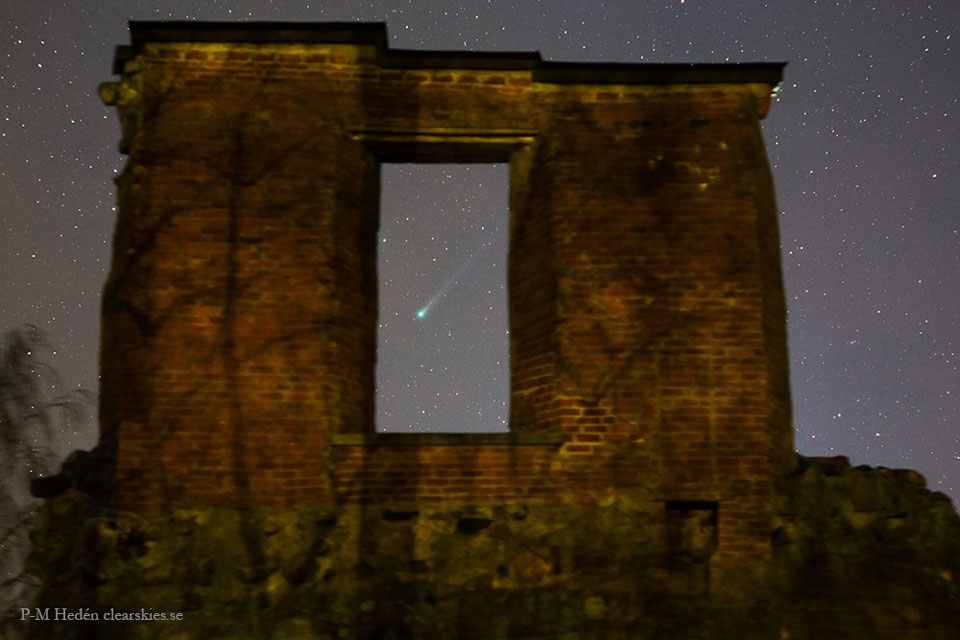
This new comet is quite photogenic. Comet Lovejoy, discovered only three months ago, was imaged through ruins of ancient M�rby Castle in Sweden last week sporting a green-glowing coma and tails trailing several degrees. The past few weeks have been an unusually active time for comet watchers as four comets were visible simultaneously with binoculars: ISON, Lovejoy, Encke, and LINEAR. C/2013 R1 (Lovejoy) comet is currently visible to the unaided eye from a dark location. As Monday's new Moon will provide little glare, the next few days provide a good time to see Comet Lovejoy as it reaches its peak brightness. In two and a half weeks, Comet Lovejoy will reach its closest approach to the Sun at a distance just inside the orbital distance of the Earth. Late ISON News: Multiple views from Sun-observing spacecraft