The Sun
The Sun is a yellow dwarf star (G2V), about 4.6 billion years old, and the dominant gravitational force in the Solar System. It has a diameter of roughly 1.4 million kilometers and contains around 99.8% of the Solar System’s mass. Nuclear fusion in its core converts hydrogen into helium, producing energy that warms the planets. Above the core lie the radiative and convective zones, followed by the visible photosphere (~5,500 °C), the chromosphere, and the much hotter corona (~2 million °C).
Source: science.nasa.gov
APODs including "The Sun"
Sun and Prominence
04/03/2014
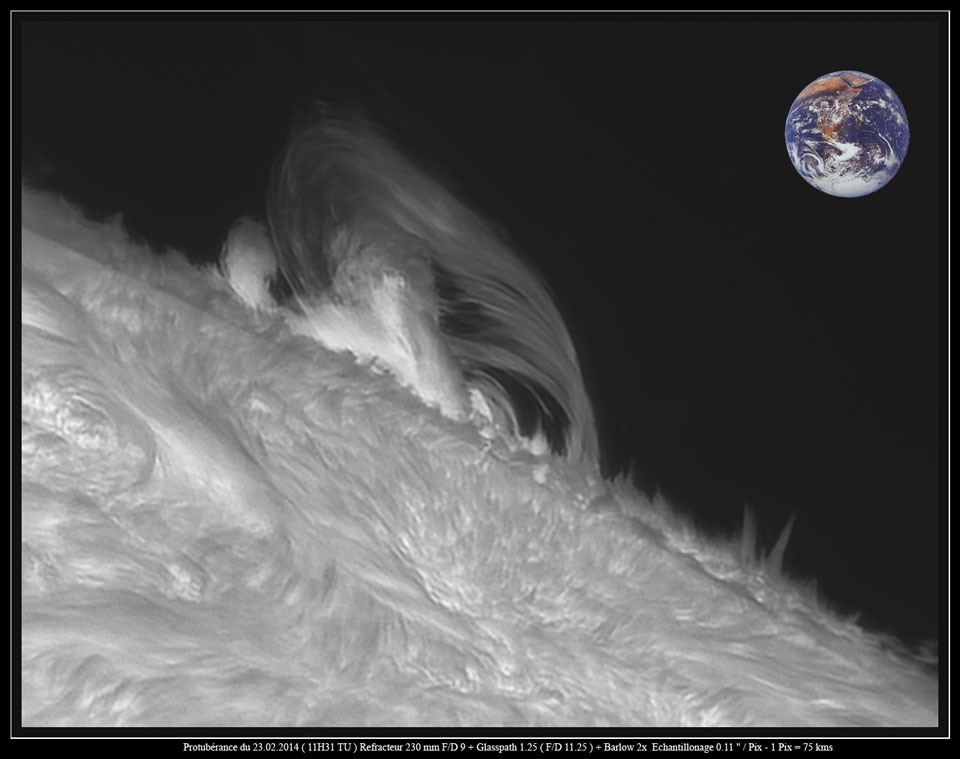
Dramatic prominences can sometimes be seen looming just beyond the edge of the sun. Such was the case last week as a large prominence, visible above, highlighted a highly active recent Sun. A waving sea of hot gas is visible in the foreground chromosphere in great detail as it was imaged in one specific color of light emitted by hydrogen. A solar prominence is a cloud of solar gas held just above the surface by the Sun's magnetic field. The Earth, illustrated in the inset, is smaller than the prominence. Although very hot, prominences typically appear dark when viewed against the Sun, since they are slightly cooler than the photosphere below them. A quiescent prominence typically lasts about a month, and may erupt in a Coronal Mass Ejection (CME) expelling hot gas into the Solar System, some of which may strike the Earth and trigger auroras.