The Sun
The Sun is a yellow dwarf star (G2V), about 4.6 billion years old, and the dominant gravitational force in the Solar System. It has a diameter of roughly 1.4 million kilometers and contains around 99.8% of the Solar System’s mass. Nuclear fusion in its core converts hydrogen into helium, producing energy that warms the planets. Above the core lie the radiative and convective zones, followed by the visible photosphere (~5,500 °C), the chromosphere, and the much hotter corona (~2 million °C).
Source: science.nasa.gov
APODs including "The Sun"
2012 VP113: A New Furthest Known Orbit in the Solar System
31/03/2014
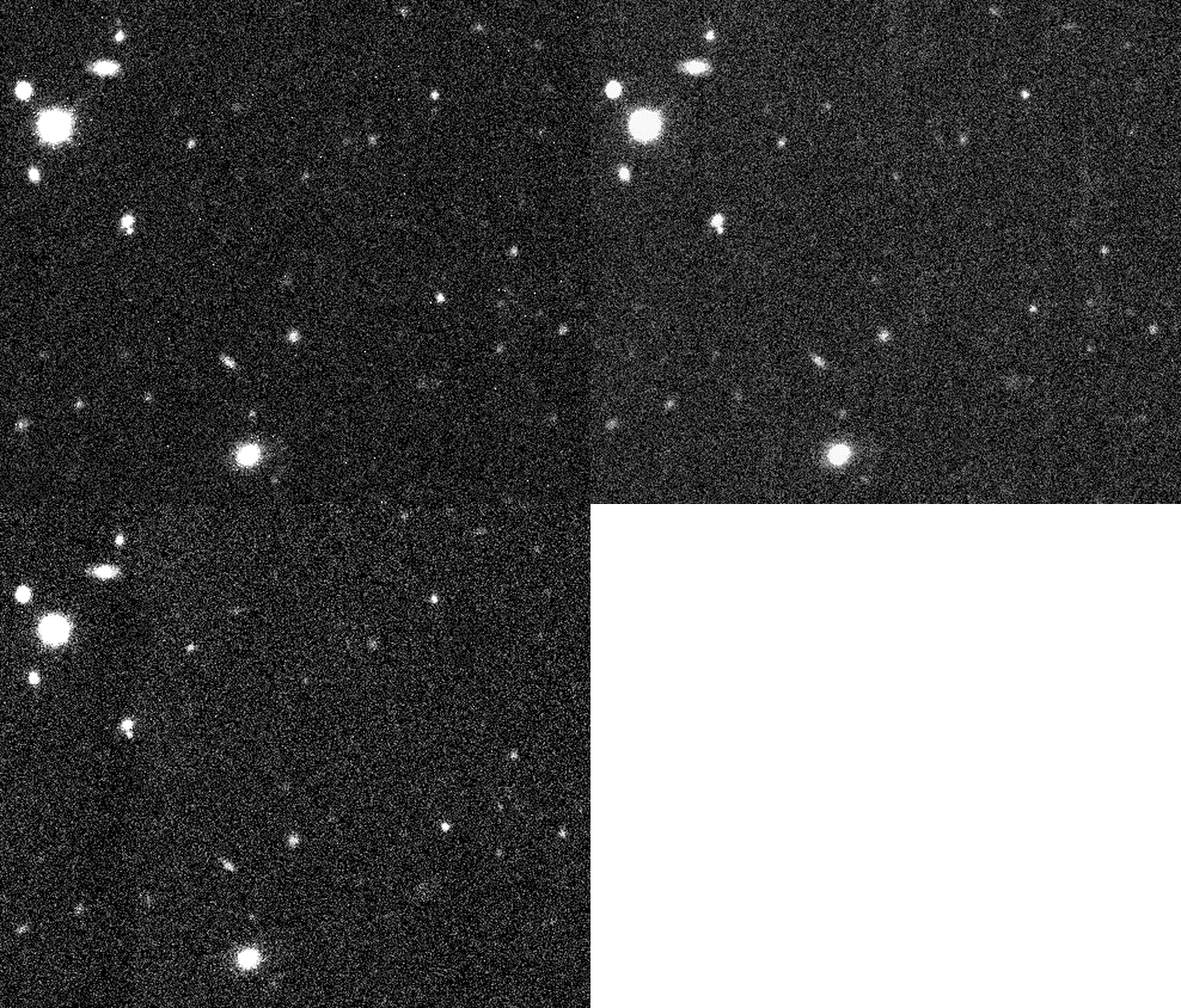
What object has the furthest known orbit in our Solar System? In terms of how close it will ever get to the Sun, the new answer is 2012 VP113, an object currently over twice the distance of Pluto from the Sun. Pictured above is a series of discovery images taken with the Dark Energy Camera attached to the NOAO's Blanco 4-meter Telescope in Chile in 2012 and released last week. The distant object, seen moving on the lower right, is thought to be a dwarf planet like Pluto. Previously, the furthest known dwarf planet was Sedna, discovered in 2003. Given how little of the sky was searched, it is likely that as many as 1,000 more objects like 2012 VP113 exist in the outer Solar System. 2012 VP113 is currently near its closest approach to the Sun, in about 2,000 years it will be over five times further. Some scientists hypothesize that the reason why objects like Sedna and 2012 VP113 have their present orbits is because they were gravitationally scattered there by a much larger object -- possibly a very distant undiscovered planet.