The Sun
The Sun is a yellow dwarf star (G2V), about 4.6 billion years old, and the dominant gravitational force in the Solar System. It has a diameter of roughly 1.4 million kilometers and contains around 99.8% of the Solar System’s mass. Nuclear fusion in its core converts hydrogen into helium, producing energy that warms the planets. Above the core lie the radiative and convective zones, followed by the visible photosphere (~5,500 °C), the chromosphere, and the much hotter corona (~2 million °C).
Source: science.nasa.gov
APODs including "The Sun"
A Solar Eclipse from the Moon
07/04/2014
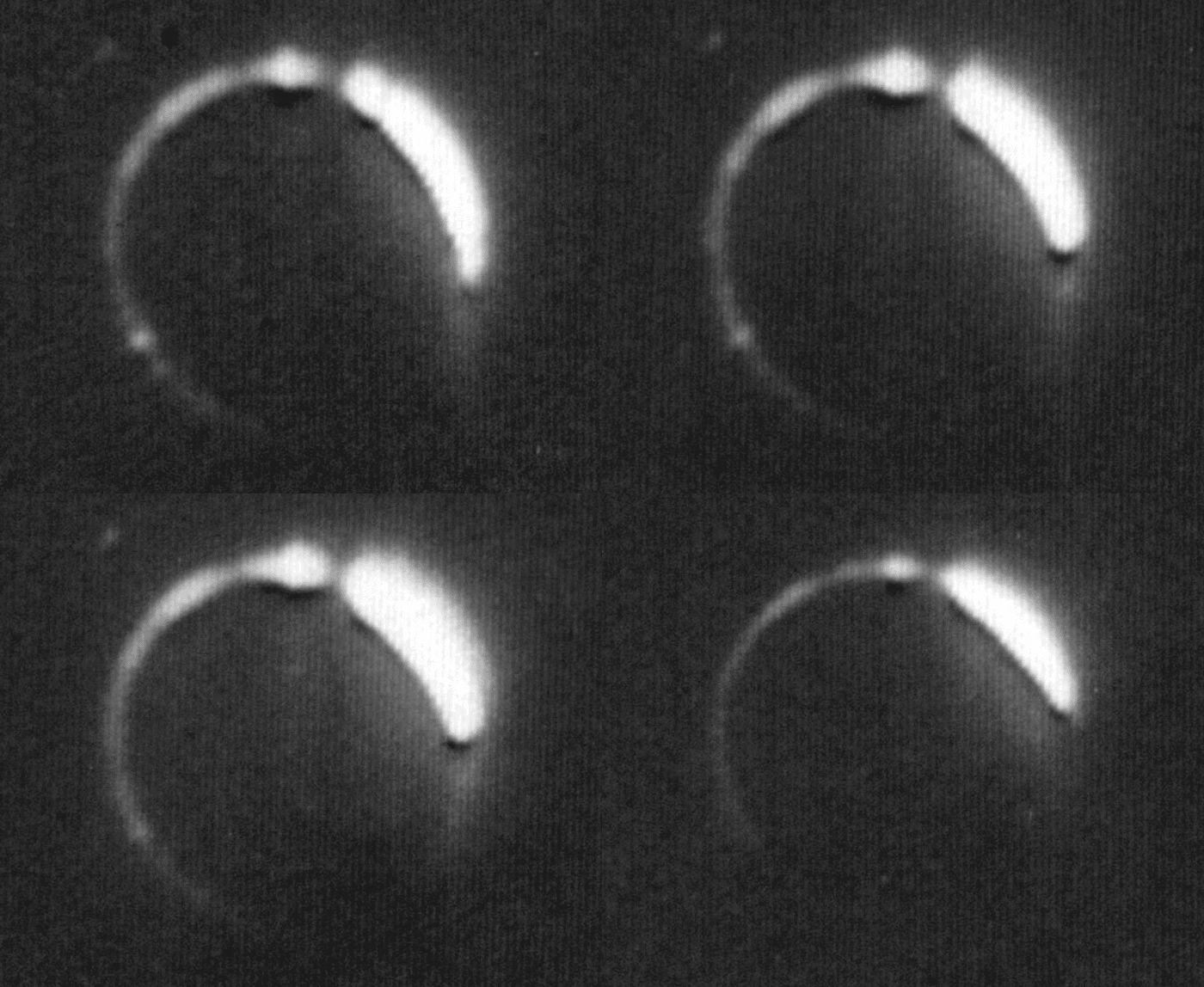
Has a solar eclipse ever been seen from the Moon? Yes, first in 1967 -- but it may happen again next week. The robotic Surveyor 3 mission took thousands of wide angle television images of the Earth in 1967, a few of which captured the Earth moving in front of the Sun. Several of these images have been retrieved from the NASA archives and compiled into the above time-lapse video. Although the images are grainy, the Earth's atmosphere clearly refracted sunlight around it and showed a beading effect when some paths were blocked by clouds. Two years later, in 1969, the Apollo 12 crew saw firsthand a different eclipse of the Sun by the Earth on the way back from the Moon. In 2009, Japan's robotic Kaguya spacecraft took higher resolution images of a similar eclipse while orbiting the Moon. Next week, however, China's Chang'e 3 mission, including its Yutu rover, might witness a new total eclipse of the Sun by the Earth from surface of the Moon. Simultaneously, from lunar orbit, NASA's LADEE mission might also capture the unusual April 15 event. Another angle of this same event will surely be visible to people on Earth -- a total lunar eclipse.