The Sun
The Sun is a yellow dwarf star (G2V), about 4.6 billion years old, and the dominant gravitational force in the Solar System. It has a diameter of roughly 1.4 million kilometers and contains around 99.8% of the Solar System’s mass. Nuclear fusion in its core converts hydrogen into helium, producing energy that warms the planets. Above the core lie the radiative and convective zones, followed by the visible photosphere (~5,500 °C), the chromosphere, and the much hotter corona (~2 million °C).
Source: science.nasa.gov
APODs including "The Sun"
Brisbane Sunset Moonset
01/05/2014
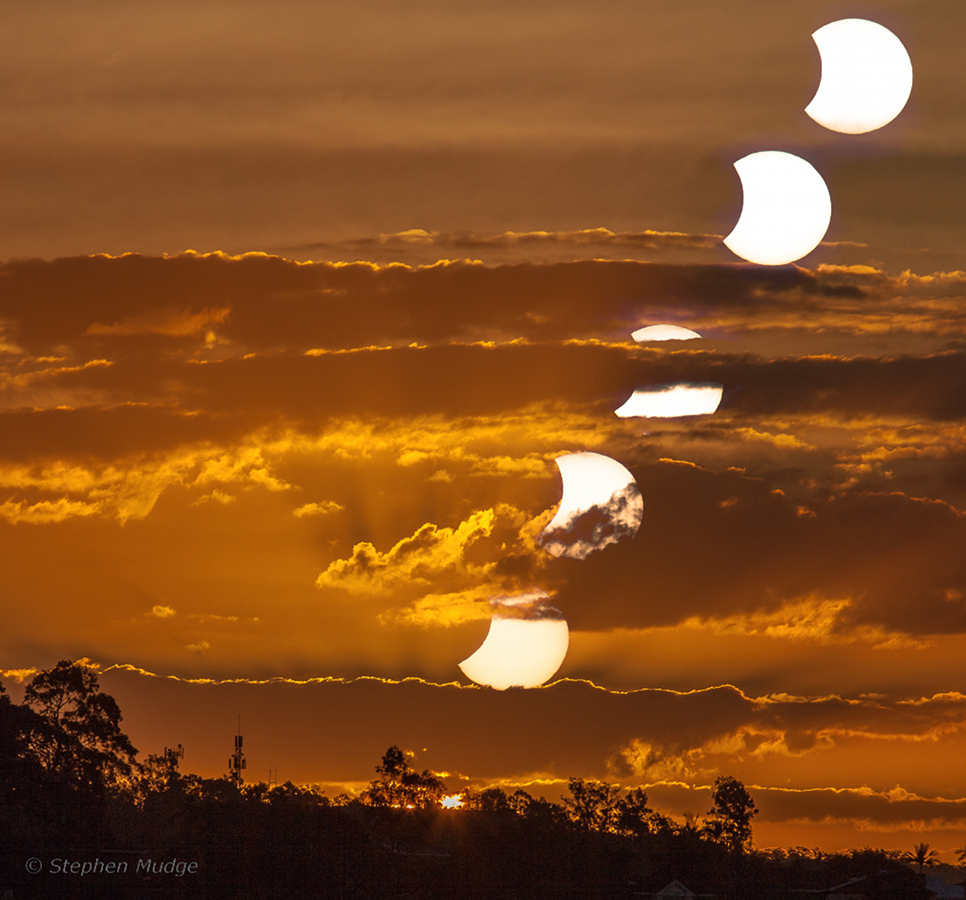
In skies over Brisbane at the southeastern corner of Queensland, Australia, Planet Earth, the Sun and New Moon set together on April 29. There the celestial line-up, the first solar eclipse of 2014, was seen as a partial solar eclipse. This dramatic composite is a digital stack of images taken about 5 minutes apart with telephoto lens and solar filter. It follows the eclipse in progress, approaching a western horizon where crepuscular rays from cloud banks in silhouette joined the silhouetted Moon. From Brisbane, the maximum eclipse phase with the Moon covering about 25% of the Sun occurred just after sunset. Only from a remote spot on the continent of Antarctica was it even possible to see the eclipse in its brief annular phase, the entire dark lunar disk surrounded by a thin, bright ring of fire.