The Sun
The Sun is a yellow dwarf star (G2V), about 4.6 billion years old, and the dominant gravitational force in the Solar System. It has a diameter of roughly 1.4 million kilometers and contains around 99.8% of the Solar System’s mass. Nuclear fusion in its core converts hydrogen into helium, producing energy that warms the planets. Above the core lie the radiative and convective zones, followed by the visible photosphere (~5,500 °C), the chromosphere, and the much hotter corona (~2 million °C).
Source: science.nasa.gov
APODs including "The Sun"
Rosetta's Target Comet
23/05/2014
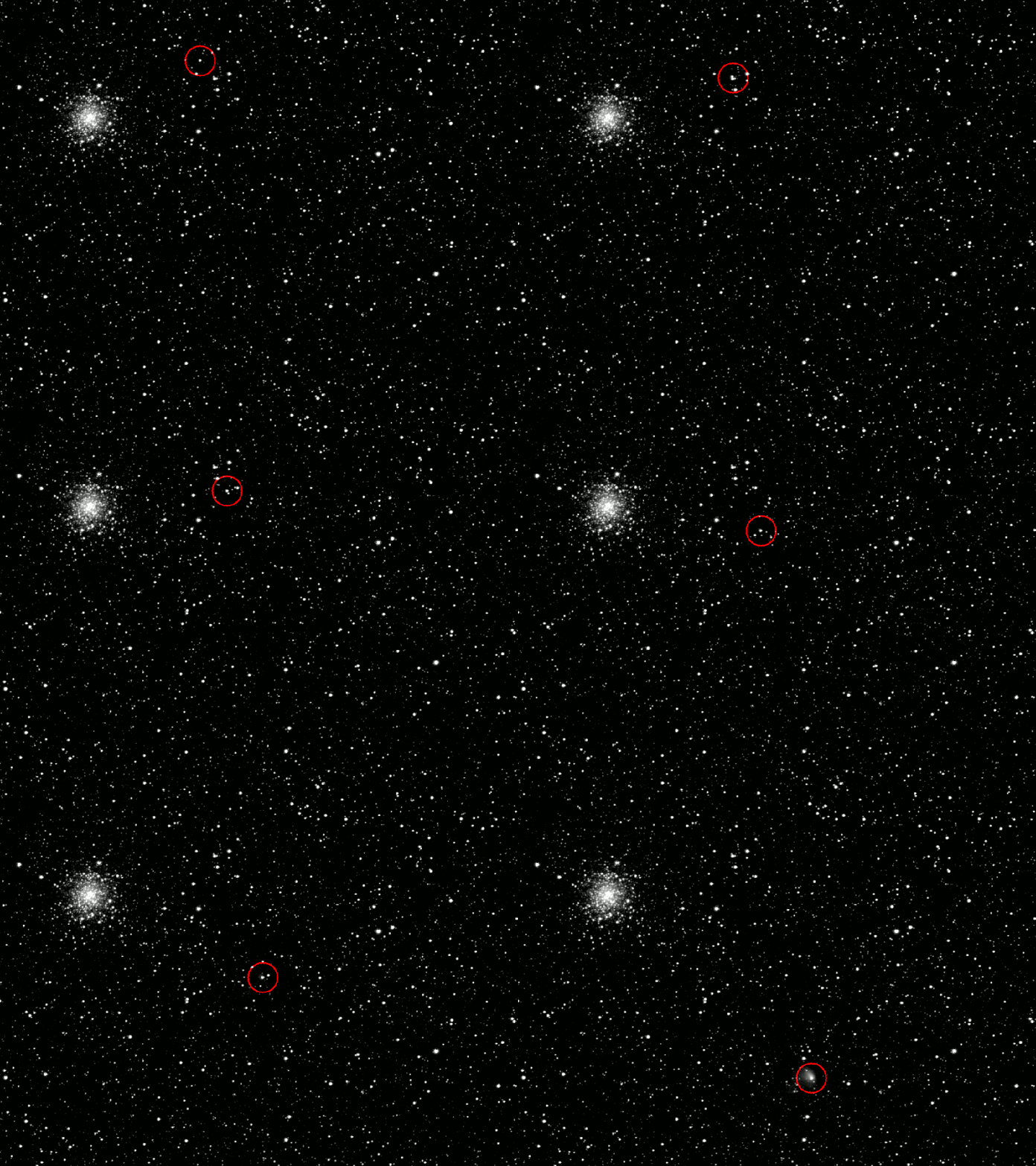
The Rosetta spacecraft captured this remarkable series of 9 frames between March 27 and May 4, as it closed from 5 million to 2 million kilometers of its target comet. Cruising along a 6.5 year orbit toward closest approach to the Sun next year, periodic comet 67P/Churyumov-Gerasimenko is seen moving past a distant background of stars in Ophiuchus and globular star cluster M107. The comet's developing coma is actually visible by the end of the sequence, extending for some 1300 km into space. Rosetta is scheduled for an early August rendezvous with the comet's nucleus. Now clearly active, the nucleus is about 4 kilometers in diameter, releasing the dusty coma as its dirty ices begin to sublimate in the sunlight. The Rosetta lander's contact with the surface of the nucleus is anticipated in November. Meteor Shower Hunt Tonight: Looking for the Camelopardalids