The Sun
The Sun is a yellow dwarf star (G2V), about 4.6 billion years old, and the dominant gravitational force in the Solar System. It has a diameter of roughly 1.4 million kilometers and contains around 99.8% of the Solar System’s mass. Nuclear fusion in its core converts hydrogen into helium, producing energy that warms the planets. Above the core lie the radiative and convective zones, followed by the visible photosphere (~5,500 °C), the chromosphere, and the much hotter corona (~2 million °C).
Source: science.nasa.gov
APODs including "The Sun"
Conjunction by the Sea
26/06/2014
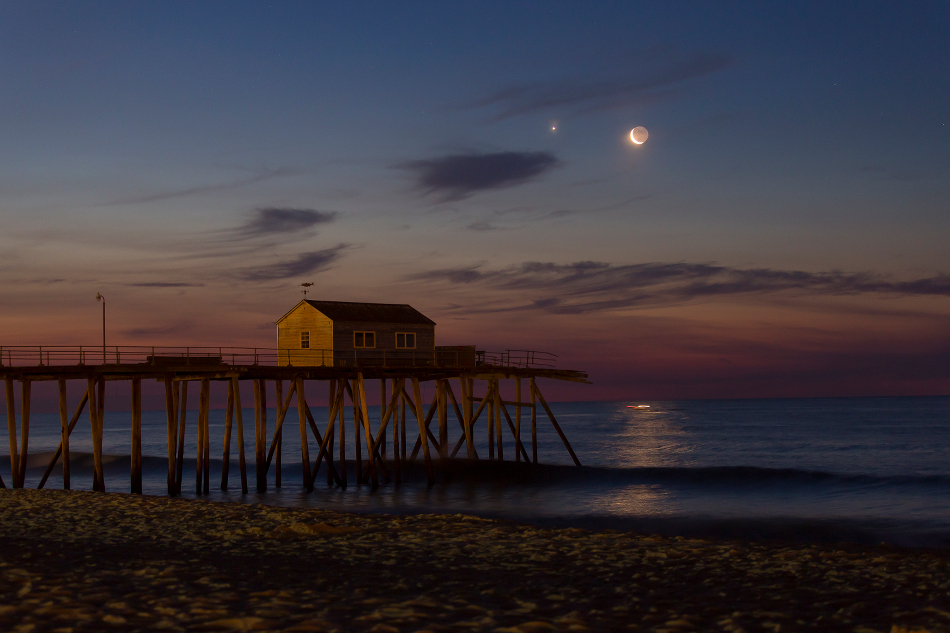
rly morning risers were treated to a beautiful conjunction of Venus and waning Crescent Moon on June 24, captured in this seaside photo near Belmar, New Jersey, USA, planet Earth. The serene celestial pairing is seen above the Atlantic Ocean horizon as the eastern sky grows brighter with dawn's early light. Wispy, scattered clouds appear in silhouette. But the exposure also reveals the night side of the lunar orb in the arms of the sunlit crescent. That shadowed part of the Moon, with hints of the smooth, dark lunar seas or maria, is illuminated by Earthshine, sunlight reflected from planet Earth itself.