The Sun
The Sun is a yellow dwarf star (G2V), about 4.6 billion years old, and the dominant gravitational force in the Solar System. It has a diameter of roughly 1.4 million kilometers and contains around 99.8% of the Solar System’s mass. Nuclear fusion in its core converts hydrogen into helium, producing energy that warms the planets. Above the core lie the radiative and convective zones, followed by the visible photosphere (~5,500 °C), the chromosphere, and the much hotter corona (~2 million °C).
Source: science.nasa.gov
APODs including "The Sun"
Manhattanhenge: A New York City Sunset
06/07/2014
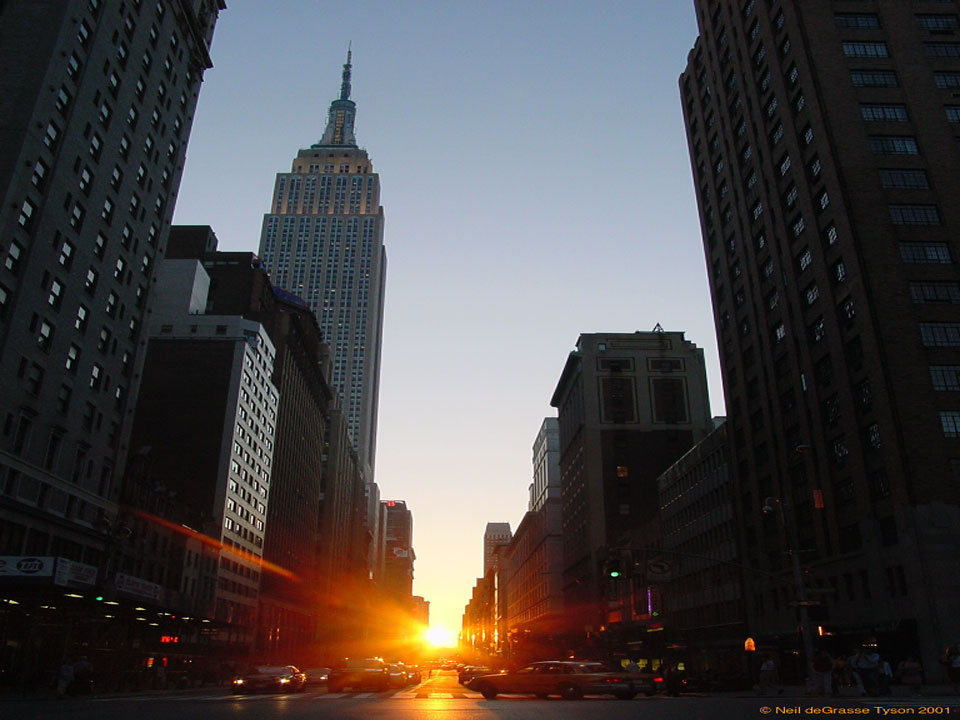
This coming Saturday, if it is clear, well placed New Yorkers can go outside at sunset and watch their city act like a modern version of Stonehenge. Manhattan's streets will flood dramatically with sunlight just as the Sun sets precisely at each street's western end. Usually, the tall buildings that line the gridded streets of New York City's tallest borough will hide the setting Sun. This effect makes Manhattan a type of modern Stonehenge, although only aligned to about 30 degrees east of north. Were Manhattan's road grid perfectly aligned to east and west, today's effect would occur on the Vernal and Autumnal Equinox, March 21 and September 21, the only two days that the Sun rises and sets due east and west. Pictured above in this horizontally stretched image, the Sun sets down 34th Street as viewed from Park Avenue. If Saturday's sunset is hidden by clouds do not despair -- the same thing happens twice each year: in late May and mid July. On none of these occasions, however, should you ever look directly at the Sun.