The Sun
The Sun is a yellow dwarf star (G2V), about 4.6 billion years old, and the dominant gravitational force in the Solar System. It has a diameter of roughly 1.4 million kilometers and contains around 99.8% of the Solar System’s mass. Nuclear fusion in its core converts hydrogen into helium, producing energy that warms the planets. Above the core lie the radiative and convective zones, followed by the visible photosphere (~5,500 °C), the chromosphere, and the much hotter corona (~2 million °C).
Source: science.nasa.gov
APODs including "The Sun"
Spotty Sunrise over Brisbane
11/07/2014
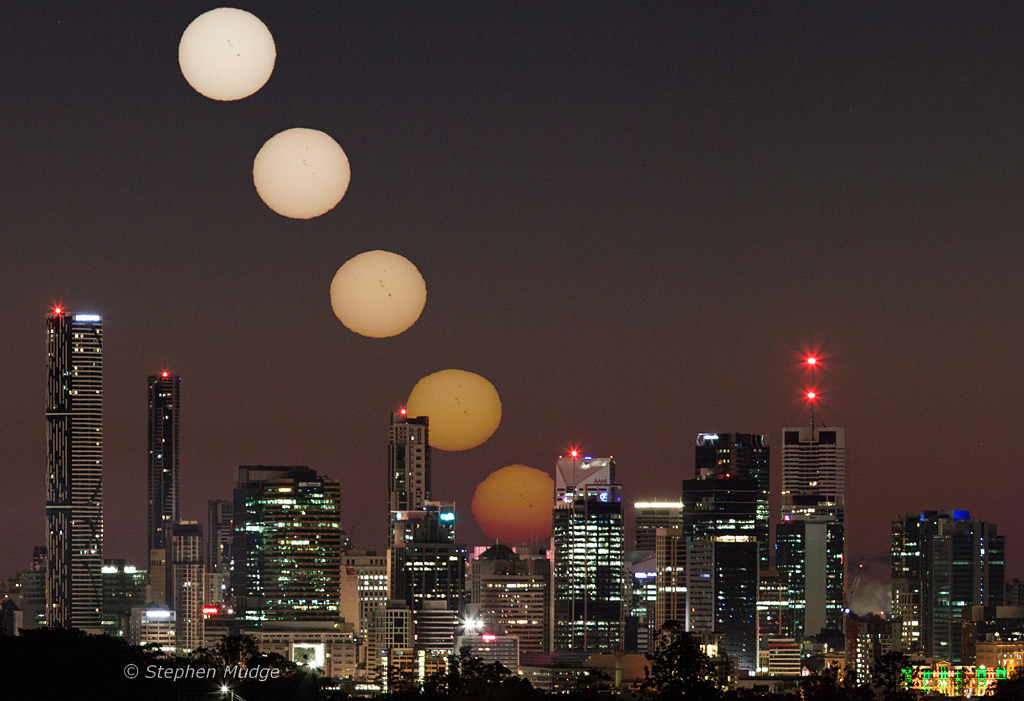
In this composite cityscape, dawn's first colors backdrop the lights along Brisbane's skyline at the southeastern corner of Queensland, Australia, planet Earth. Using a solar filter, additional exposures made every 3.5 minutes follow the winter sunrise on July 8 as planet-sized sunspots cross the visible solar disk. The sunspots mark solar active regions with convoluted magnetic fields. Even as the maximum in the solar activity cycle begins to fade, the active regions produce intense solar flares and eruptions launching coronal mass ejections (CMEs), enormous clouds of energetic particles, into our fair solar system.