The Sun
The Sun is a yellow dwarf star (G2V), about 4.6 billion years old, and the dominant gravitational force in the Solar System. It has a diameter of roughly 1.4 million kilometers and contains around 99.8% of the Solar System’s mass. Nuclear fusion in its core converts hydrogen into helium, producing energy that warms the planets. Above the core lie the radiative and convective zones, followed by the visible photosphere (~5,500 °C), the chromosphere, and the much hotter corona (~2 million °C).
Source: science.nasa.gov
APODs including "The Sun"
Venus and Jupiter at Dawn
21/08/2014
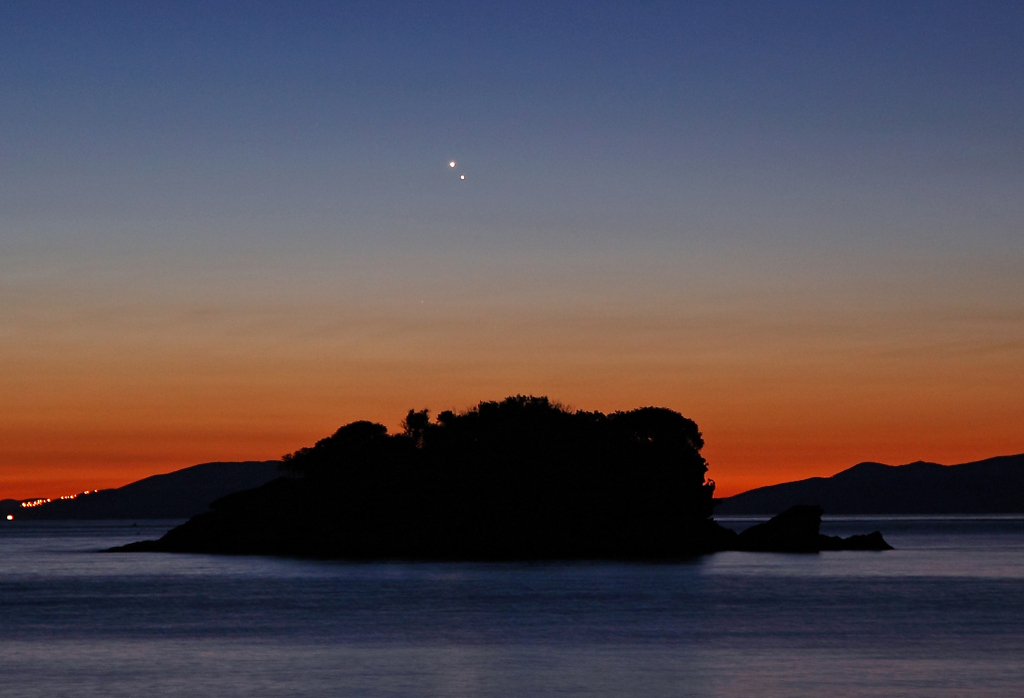
On Monday morning, Venus and Jupiter gathered close in dawn skies, for some separated by about half the width of a full moon. It was their closest conjunction since 2000, captured here above the eastern horizon before sunrise. The serene and colorful view is from Istia beach near the city of Capoliveri on the island of Elba. Distant lights and rolling hills are along Italy's Tuscan coast. Of course, the celestial pair soon wandered apart. Brighter Venus headed lower, toward the eastern horizon and the glare of the Sun, while Jupiter continues to rise a little higher now in the sky near dawn. The two brightest planets meet again next June 30th, in the evening twilight above the western horizon.