The Sun
The Sun is a yellow dwarf star (G2V), about 4.6 billion years old, and the dominant gravitational force in the Solar System. It has a diameter of roughly 1.4 million kilometers and contains around 99.8% of the Solar System’s mass. Nuclear fusion in its core converts hydrogen into helium, producing energy that warms the planets. Above the core lie the radiative and convective zones, followed by the visible photosphere (~5,500 °C), the chromosphere, and the much hotter corona (~2 million °C).
Source: science.nasa.gov
APODs including "The Sun"
From the Temple of the Sun to the Temple of the Moon
07/10/2014
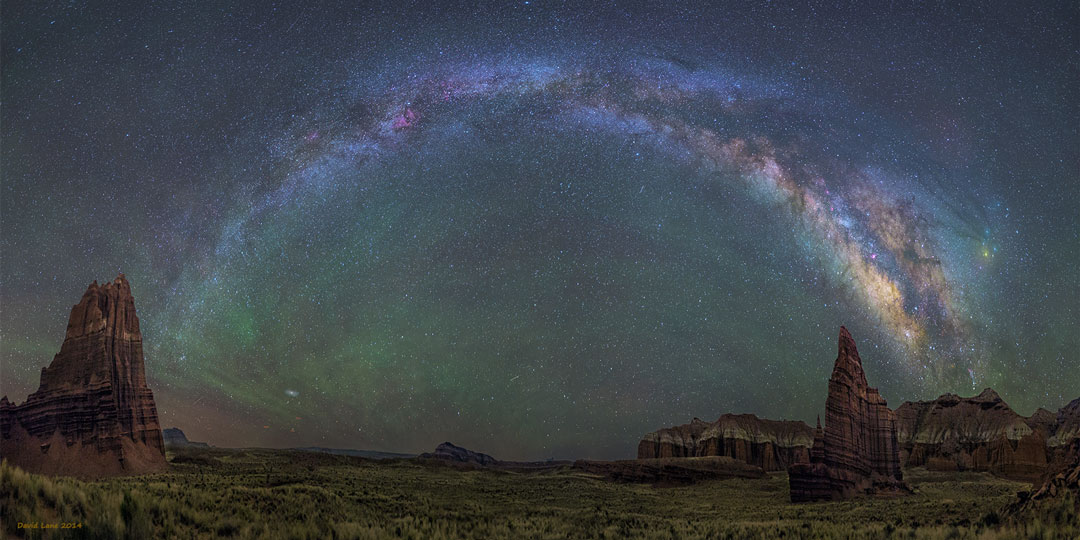
What connects the Sun to the Moon? Many answers have been given throughout history, but in the case of today's featured image, it appears to be the plane of our Milky Way Galaxy. The 16-image panorama was taken in Capitol Reef National Park, Utah, USA where two sandstone monoliths -- the Temple of the Moon on the right and the Temple of the Sun on the left -- rise dramatically from the desert. Each natural monument stands about 100 meters tall and survives from the Jurassic period 160 million years ago. Even older are many of the stars and nebulas that dot the celestial background, including the Andromeda Galaxy. Tomorrow the Earth will connect the Sun to the Moon by way of its shadow: a total lunar eclipse will be visible from many locations around the globe. New: Follow APOD on Ello