The Sun
The Sun is a yellow dwarf star (G2V), about 4.6 billion years old, and the dominant gravitational force in the Solar System. It has a diameter of roughly 1.4 million kilometers and contains around 99.8% of the Solar System’s mass. Nuclear fusion in its core converts hydrogen into helium, producing energy that warms the planets. Above the core lie the radiative and convective zones, followed by the visible photosphere (~5,500 °C), the chromosphere, and the much hotter corona (~2 million °C).
Source: science.nasa.gov
APODs including "The Sun"
Sunspots and Solar Eclipse
25/10/2014
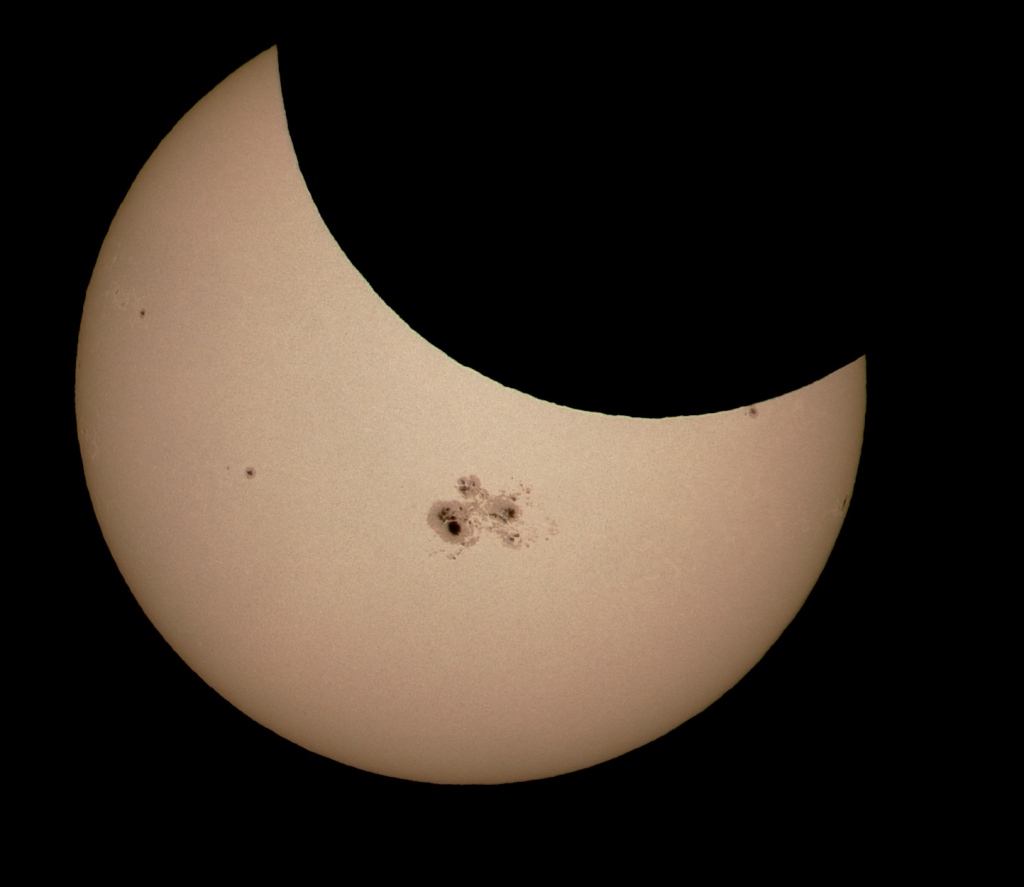
A New Moon joined giant sunspot group AR 2192 to dim the bright solar disk during Thursday's much anticipated partial solar eclipse. Visible from much of North America, the Moon's broad silhouette is captured in this extreme telephoto snapshot near eclipse maximum from Santa Cruz, California. About the size of Jupiter, the remarkable AR 2192 itself darkens a noticeable fraction of the Sun, near center and below the curved lunar limb. As the sunspot group slowly rotates across the Sun and out of view in the coming days its activity is difficult to forecast. But the timing of solar eclipses is easier to predict. The next will be a total solar eclipse on March 20, 2015.