The Sun
The Sun is a yellow dwarf star (G2V), about 4.6 billion years old, and the dominant gravitational force in the Solar System. It has a diameter of roughly 1.4 million kilometers and contains around 99.8% of the Solar System’s mass. Nuclear fusion in its core converts hydrogen into helium, producing energy that warms the planets. Above the core lie the radiative and convective zones, followed by the visible photosphere (~5,500 °C), the chromosphere, and the much hotter corona (~2 million °C).
Source: science.nasa.gov
APODs including "The Sun"
Solar Flare from a Sharper Sun
22/11/2014
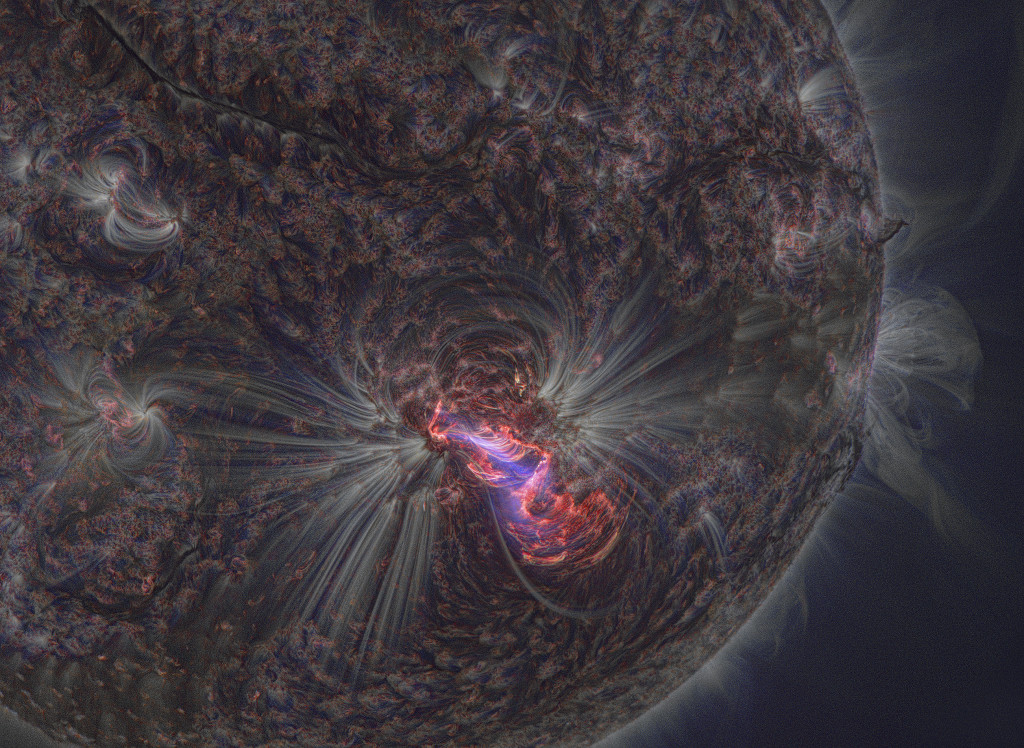
Solar active region AR2192 was the largest recorded sunspot group of the last 24 years. Before rotating off the Earth-facing side of the Sun at the end of October, it produced a whopping six energetic X-class flares. Its most intense flare was captured on October 24 in this stunning view from the orbiting Solar Dynamics Observatory. The scene is a color combination of images made at three different wavelengths of extreme ultraviolet light; 193 angstroms shown in blue, 171 angstroms in white, and 304 angstroms in red. The emission, from highly ionized Iron and Helium atoms, traces magnetic field lines looping through the hot plasma of the Sun's outer chromosphere and corona. Beneath, the cooler solar photosphere appears dark at extreme ultraviolet wavelengths. The exceptionally sharp composite image has been processed with a new mathematical algorithm (NAFE) that adapts to noise and brightness in extreme ultraviolet image data to reliably enhance small details.