The Sun
The Sun is a yellow dwarf star (G2V), about 4.6 billion years old, and the dominant gravitational force in the Solar System. It has a diameter of roughly 1.4 million kilometers and contains around 99.8% of the Solar System’s mass. Nuclear fusion in its core converts hydrogen into helium, producing energy that warms the planets. Above the core lie the radiative and convective zones, followed by the visible photosphere (~5,500 °C), the chromosphere, and the much hotter corona (~2 million °C).
Source: science.nasa.gov
APODs including "The Sun"
Geminid Fireball over Mount Balang
17/12/2014
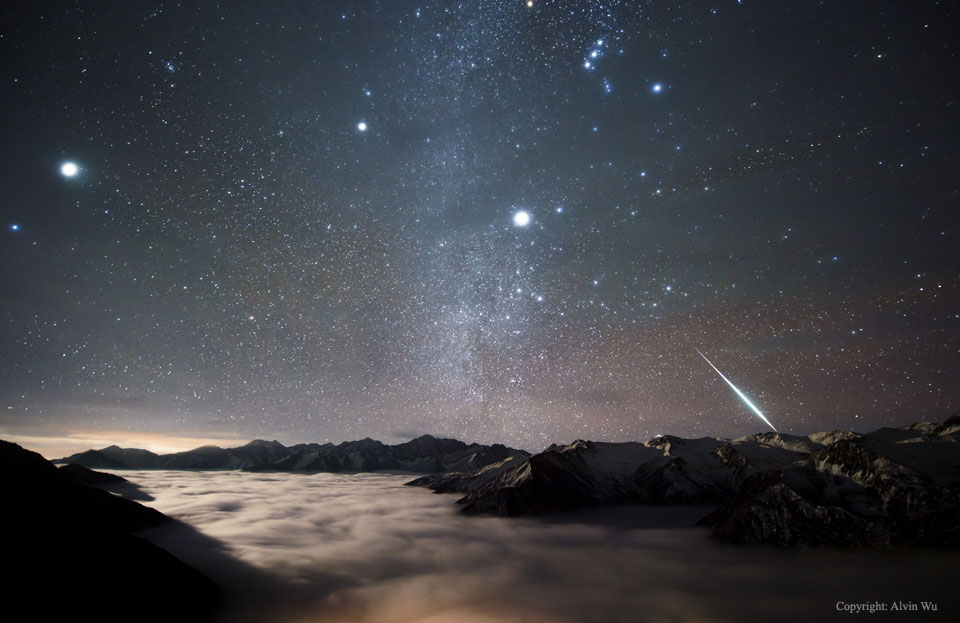
This was a sky to remember. While viewing the Geminids meteor shower a few days ago, a bright fireball was captured over Mt. Balang, China with particularly picturesque surroundings. In the foreground, a sea of light clouds slowly floated between dark mountain peaks. In the background, the constellation of Orion shone brightly, with the familiar three stars of Orion's belt visible near the image top right. Sirius, the brightest star in the night sky, is visible near the image center. The bright fireball flashed for only a fraction of second on the lower right. The source of the fireball was a pebble that intersected the protective atmosphere of Earth, originally expelled by the Sun-orbiting asteroid-like object 3200 Phaethon.