The Sun
The Sun is a yellow dwarf star (G2V), about 4.6 billion years old, and the dominant gravitational force in the Solar System. It has a diameter of roughly 1.4 million kilometers and contains around 99.8% of the Solar System’s mass. Nuclear fusion in its core converts hydrogen into helium, producing energy that warms the planets. Above the core lie the radiative and convective zones, followed by the visible photosphere (~5,500 °C), the chromosphere, and the much hotter corona (~2 million °C).
Source: science.nasa.gov
APODs including "The Sun"
Tyrrhenian Sea and Solstice Sky
21/12/2014
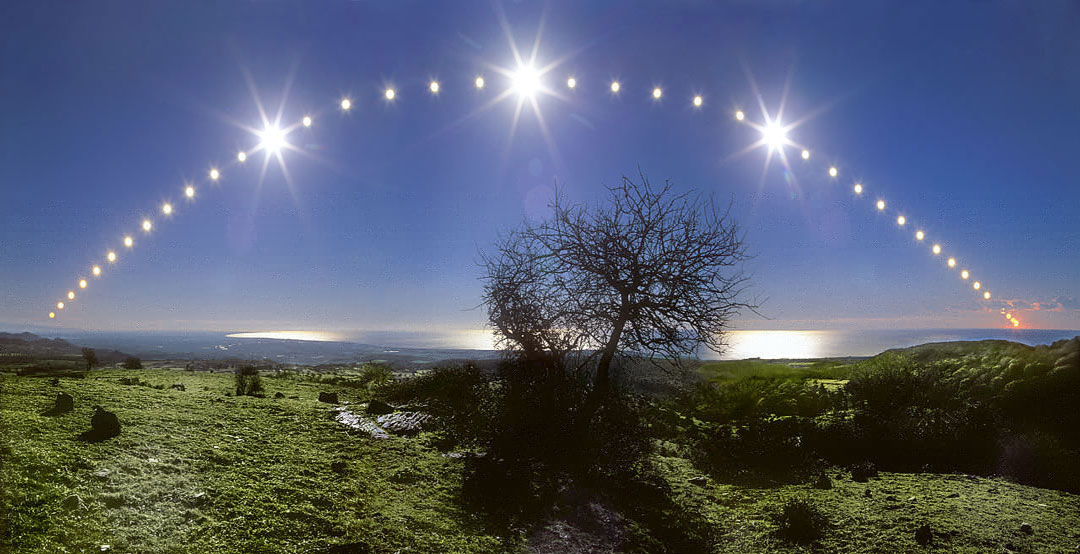
Today the solstice occurs at 23:03 Universal Time, the Sun reaching its southernmost declination in planet Earth's sky. Of course, the December solstice marks the beginning of winter in the northern hemisphere and summer in the south. When viewed from northern latitudes, and as shown in the above horizontally compressed image, the Sun will make its lowest arc through the sky along the southern horizon. So in the north, the solstice day has the shortest length of time between sunrise and sunset and fewest hours of daylight. This striking composite image follows the Sun's path through the December solstice day of 2005 in a beautiful blue sky, looking down the Tyrrhenian Sea coast from Santa Severa toward Fiumicino, Italy. The view covers about 115 degrees in 43 separate, well-planned exposures from sunrise to sunset. Follow APOD on: Facebook, Google Plus, or Twitter