The Sun
The Sun is a yellow dwarf star (G2V), about 4.6 billion years old, and the dominant gravitational force in the Solar System. It has a diameter of roughly 1.4 million kilometers and contains around 99.8% of the Solar System’s mass. Nuclear fusion in its core converts hydrogen into helium, producing energy that warms the planets. Above the core lie the radiative and convective zones, followed by the visible photosphere (~5,500 °C), the chromosphere, and the much hotter corona (~2 million °C).
Source: science.nasa.gov
APODs including "The Sun"
Comet Lovejoy before a Globular Star Cluster
31/12/2014
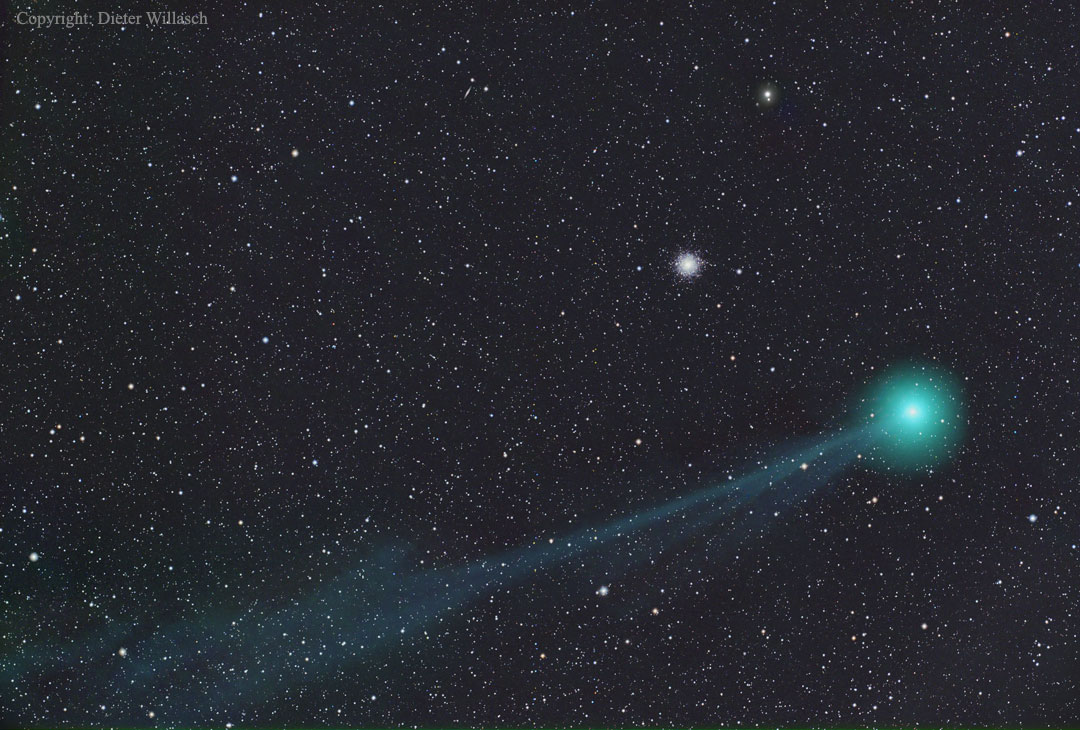
Comet Lovejoy has become visible to the unaided eye. To see the comet, just go outside an hour or so after sunset and look for a fuzzy patch to the right of Orion's belt. Binoculars and a star chart may help. Pictured here, Comet C/2014 Q2 (Lovejoy) was captured three days ago passing nearly in front of M79, the globular star cluster visible as the bright spot slightly above and to the left of the comet's green-hued coma. The nucleus of Comet Lovejoy is a giant dirty iceberg that is shedding gas into a long and intricate ion tail, extending across the image, as it nears the Sun. The comet is expected to become even easier to spot for northern observers during January, as it is rises earlier and, hopefully, continues to brighten.