The Sun
The Sun is a yellow dwarf star (G2V), about 4.6 billion years old, and the dominant gravitational force in the Solar System. It has a diameter of roughly 1.4 million kilometers and contains around 99.8% of the Solar System’s mass. Nuclear fusion in its core converts hydrogen into helium, producing energy that warms the planets. Above the core lie the radiative and convective zones, followed by the visible photosphere (~5,500 °C), the chromosphere, and the much hotter corona (~2 million °C).
Source: science.nasa.gov
APODs including "The Sun"
The Great Wall by Moonlight
13/03/2015
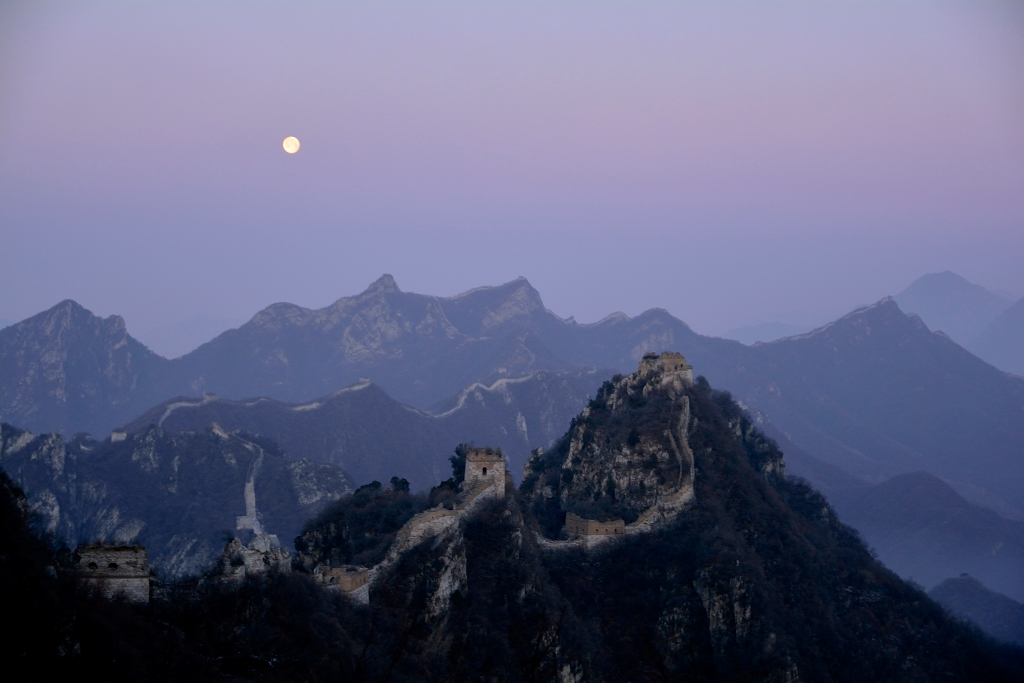
Last Friday, an almost Full Moon rose as the Sun set, over this mountainous landscape north of Beijing, China. Also near apogee, the farthest point in its elliptical orbit around planet Earth, it was this year's smallest and faintest Full Moon. The Jiankou section of the Great Wall of China meanders through the scene, the ancient Great Wall itself the subject of an older-than-the-space-age myth that it would be visible to the eye when standing on the lunar surface. But even from low Earth orbit, the large scale artifact of human civilization is very difficult to identify. At its farthest from our fair planet, the Moon shines brightly in the twilight sky though, posing in the faint, pinkish band known as the antitwilight arch or the belt of Venus.