The Sun
The Sun is a yellow dwarf star (G2V), about 4.6 billion years old, and the dominant gravitational force in the Solar System. It has a diameter of roughly 1.4 million kilometers and contains around 99.8% of the Solar System’s mass. Nuclear fusion in its core converts hydrogen into helium, producing energy that warms the planets. Above the core lie the radiative and convective zones, followed by the visible photosphere (~5,500 °C), the chromosphere, and the much hotter corona (~2 million °C).
Source: science.nasa.gov
APODs including "The Sun"
Green Flash at Moonrise
05/06/2015
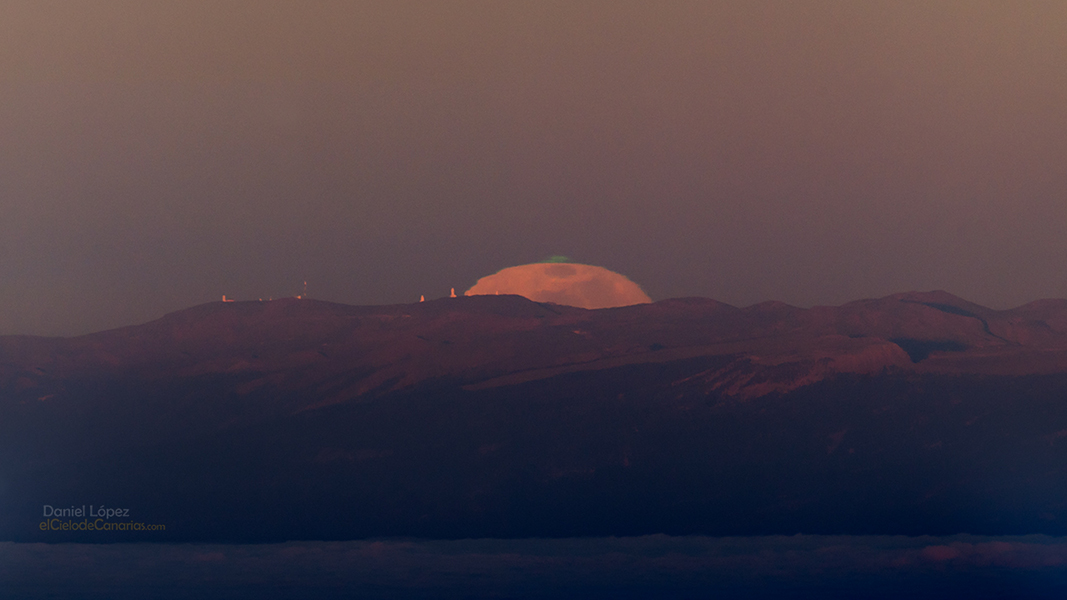
Follow a sunset on a clear day against a distant horizon and you might glimpse a green flash just as the Sun disappears, the sunlight briefly refracted over a long sight-line through atmospheric layers. You can spot a green flash at sunrise too. Pinpointing the exact place and time to see the rising Sun peeking above the horizon is a little more difficult though, and it can be harder still to catch a green flash from the fainter rising Moon. But well-planned snapshots did record a green flash at the Full Moon's upper edge on June 2nd, from the Roque de los Muchachos Observatory on the Canary Island of La Palma. Looking a little south of due east, this long telephoto view finds the rising Moon above mountains and a sea of clouds. In sunlit profile are the mountaintop Teide Observatory telescope domes on the island of Tenerife some 143 kilometers away.