The Sun
The Sun is a yellow dwarf star (G2V), about 4.6 billion years old, and the dominant gravitational force in the Solar System. It has a diameter of roughly 1.4 million kilometers and contains around 99.8% of the Solar System’s mass. Nuclear fusion in its core converts hydrogen into helium, producing energy that warms the planets. Above the core lie the radiative and convective zones, followed by the visible photosphere (~5,500 °C), the chromosphere, and the much hotter corona (~2 million °C).
Source: science.nasa.gov
APODs including "The Sun"
A Partial Solar Eclipse over Texas
13/09/2015
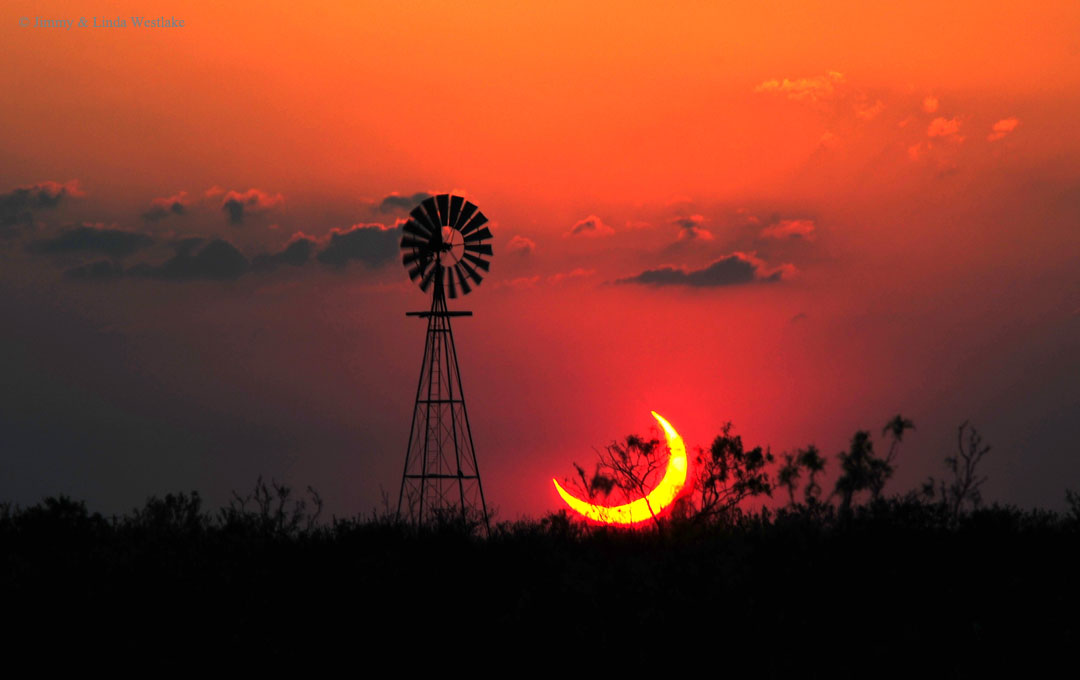
It was a typical Texas sunset except that most of the Sun was missing. The location of the missing piece of the Sun was not a mystery -- it was behind the Moon. Featured here is one of the more interesting images taken of a partial solar eclipse that occurred in 2012, capturing a temporarily crescent Sun setting in a reddened sky behind brush and a windmill. The image was taken about 20 miles west of Sundown, Texas, USA, just after the ring of fire effect was broken by the Moon moving away from the center of the Sun. Today a new partial solar eclipse of the Sun will be visible from Earth. Unfortunately for people who live in Texas, today's eclipse can only be seen from southern Africa and Antarctica.