The Sun
The Sun is a yellow dwarf star (G2V), about 4.6 billion years old, and the dominant gravitational force in the Solar System. It has a diameter of roughly 1.4 million kilometers and contains around 99.8% of the Solar System’s mass. Nuclear fusion in its core converts hydrogen into helium, producing energy that warms the planets. Above the core lie the radiative and convective zones, followed by the visible photosphere (~5,500 °C), the chromosphere, and the much hotter corona (~2 million °C).
Source: science.nasa.gov
APODs including "The Sun"
A Prominence on the Sun
19/09/2015
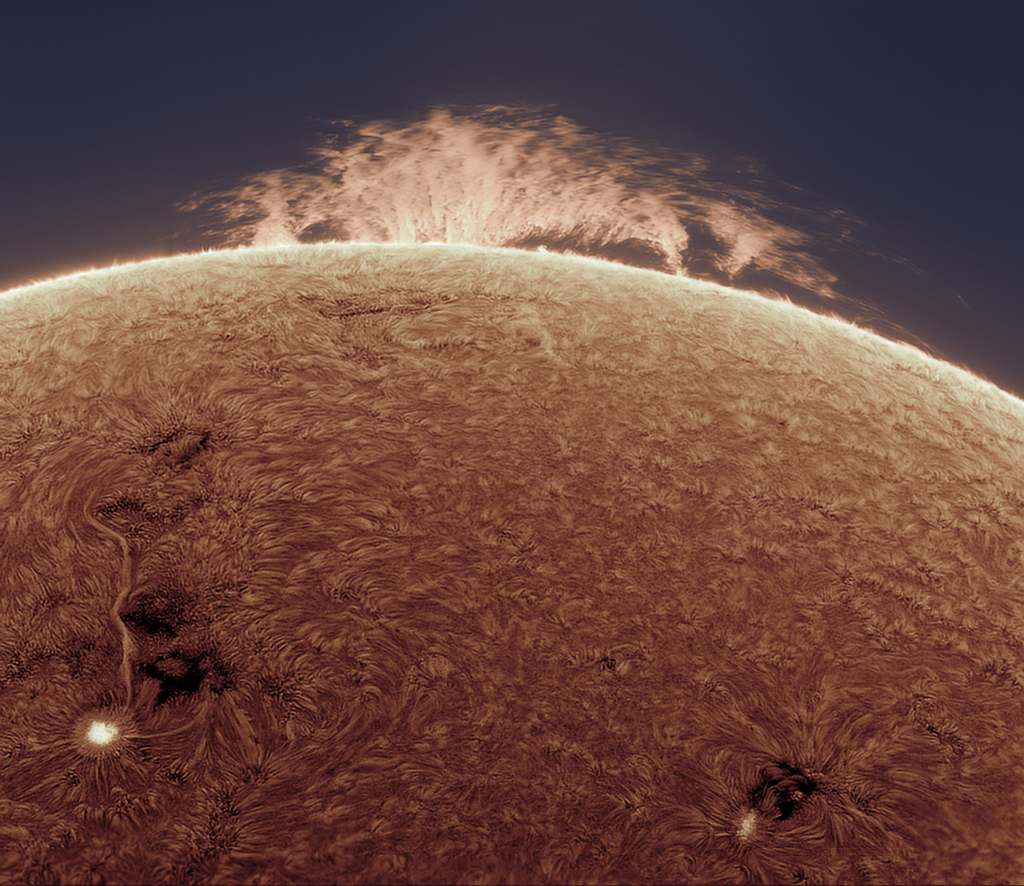
This eerie landscape of incandescent plasma suspended in looping and twisted magnetic fields stretched toward the Sun's eastern horizon on September 16. Captured through a backyard telescope and narrowband filter in light from ionized hydrogen, the scene finds bright plages near dark sunspots and a gigantic prominence lofted above the solar limb. Some 600,000 kilometers across, the magnetized plasma wall would dwarf worlds of the Solar System. Ruling gas giant Jupiter can only boast a diameter of 143,000 kilometers or so, while planet Earth's diameter is less than 13,000 kilometers. Known as a hedgerow prominence for its appearance, the enormous structure is far from stable though, and such large solar prominences often erupt.