The Sun
The Sun is a yellow dwarf star (G2V), about 4.6 billion years old, and the dominant gravitational force in the Solar System. It has a diameter of roughly 1.4 million kilometers and contains around 99.8% of the Solar System’s mass. Nuclear fusion in its core converts hydrogen into helium, producing energy that warms the planets. Above the core lie the radiative and convective zones, followed by the visible photosphere (~5,500 °C), the chromosphere, and the much hotter corona (~2 million °C).
Source: science.nasa.gov
APODs including "The Sun"
A Blue Blood Moon
03/10/2015
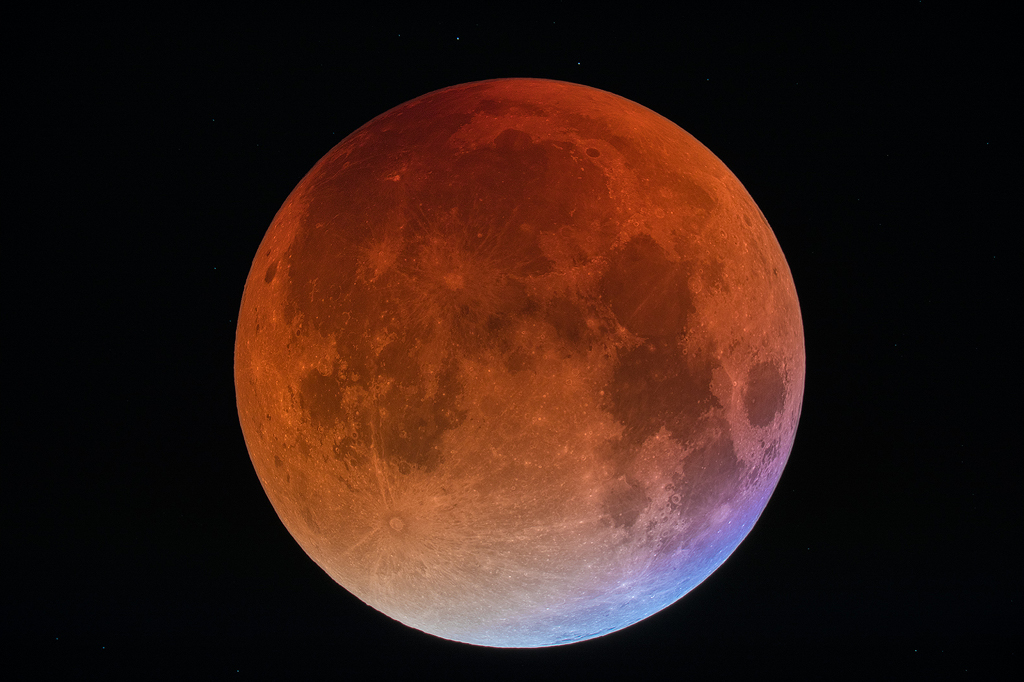
This sharp telescopic snapshot caught late September's Harvest Moon completely immersed in Earth's dark umbral shadow, at the beginning of a total lunar eclipse. It was the final eclipse in a tetrad, a string of four consecutive total lunar eclipses. A dark apparition of the Full Moon near perigee, this total eclipse's color was a deep blood red, the lunar surface reflecting light within Earth's shadow filtered through the lower atmosphere. Seen from a lunar perspective, the reddened light comes from all the sunsets and sunrises around the edges of a silhouetted Earth. But close to the shadow's edge, the limb of the eclipsed Moon shows a distinct blue hue. The blue eclipsed moonlight is still filtered through Earth's atmosphere though, originating as rays of sunlight pass through layers high in the upper stratosphere, colored by ozone that scatters red light and transmits blue.