The Sun
The Sun is a yellow dwarf star (G2V), about 4.6 billion years old, and the dominant gravitational force in the Solar System. It has a diameter of roughly 1.4 million kilometers and contains around 99.8% of the Solar System’s mass. Nuclear fusion in its core converts hydrogen into helium, producing energy that warms the planets. Above the core lie the radiative and convective zones, followed by the visible photosphere (~5,500 °C), the chromosphere, and the much hotter corona (~2 million °C).
Source: science.nasa.gov
APODs including "The Sun"
Night Hides the World
16/10/2015
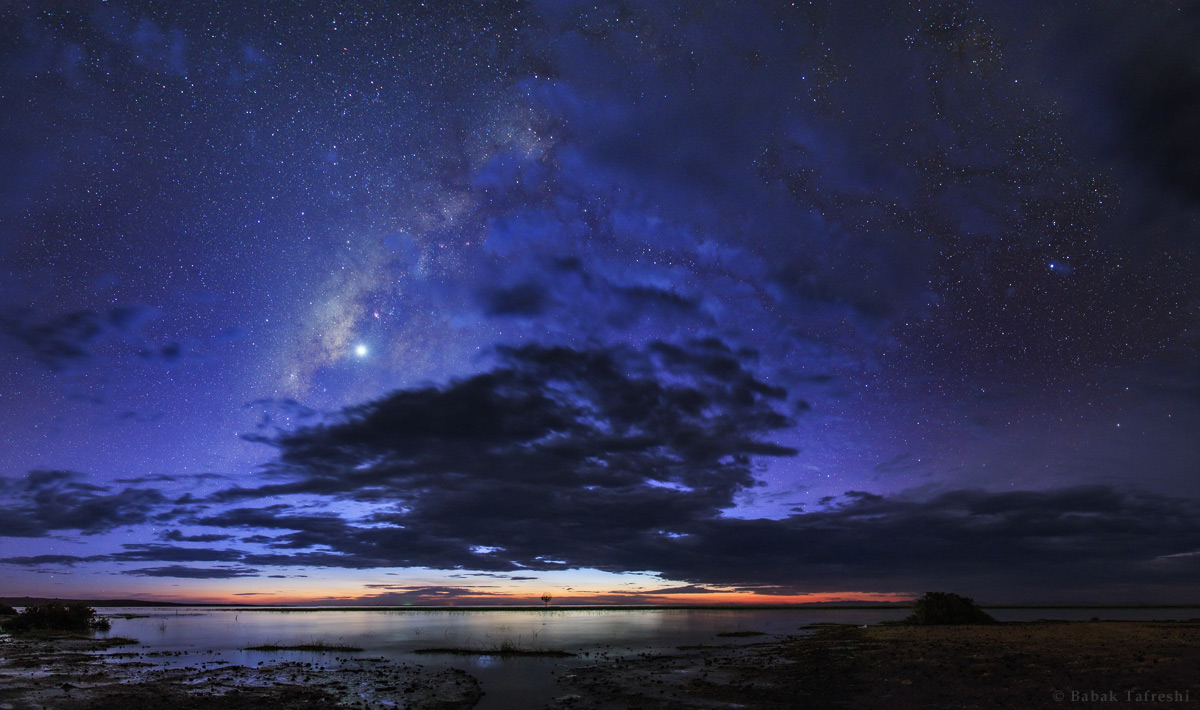
Stars come out as evening twilight fades in this serene skyscape following the Persian proverb "Night hides the world, but reveals a universe." The scene finds the Sun setting over northern Kenya and the night will soon hide the shores of Lake Turkana, home to many Nile crocodiles. The region is also known for its abundance of hominid fossils. On that past November night, a brilliant Venus, then the world's evening star, dominates the starry skies above. But also revealed are faint stars, cosmic dust clouds, and glowing nebulae along the graceful arc of our own Milky Way galaxy.