The Sun
The Sun is a yellow dwarf star (G2V), about 4.6 billion years old, and the dominant gravitational force in the Solar System. It has a diameter of roughly 1.4 million kilometers and contains around 99.8% of the Solar System’s mass. Nuclear fusion in its core converts hydrogen into helium, producing energy that warms the planets. Above the core lie the radiative and convective zones, followed by the visible photosphere (~5,500 °C), the chromosphere, and the much hotter corona (~2 million °C).
Source: science.nasa.gov
APODs including "The Sun"
A Sudden Jet on Comet 67P
18/11/2015
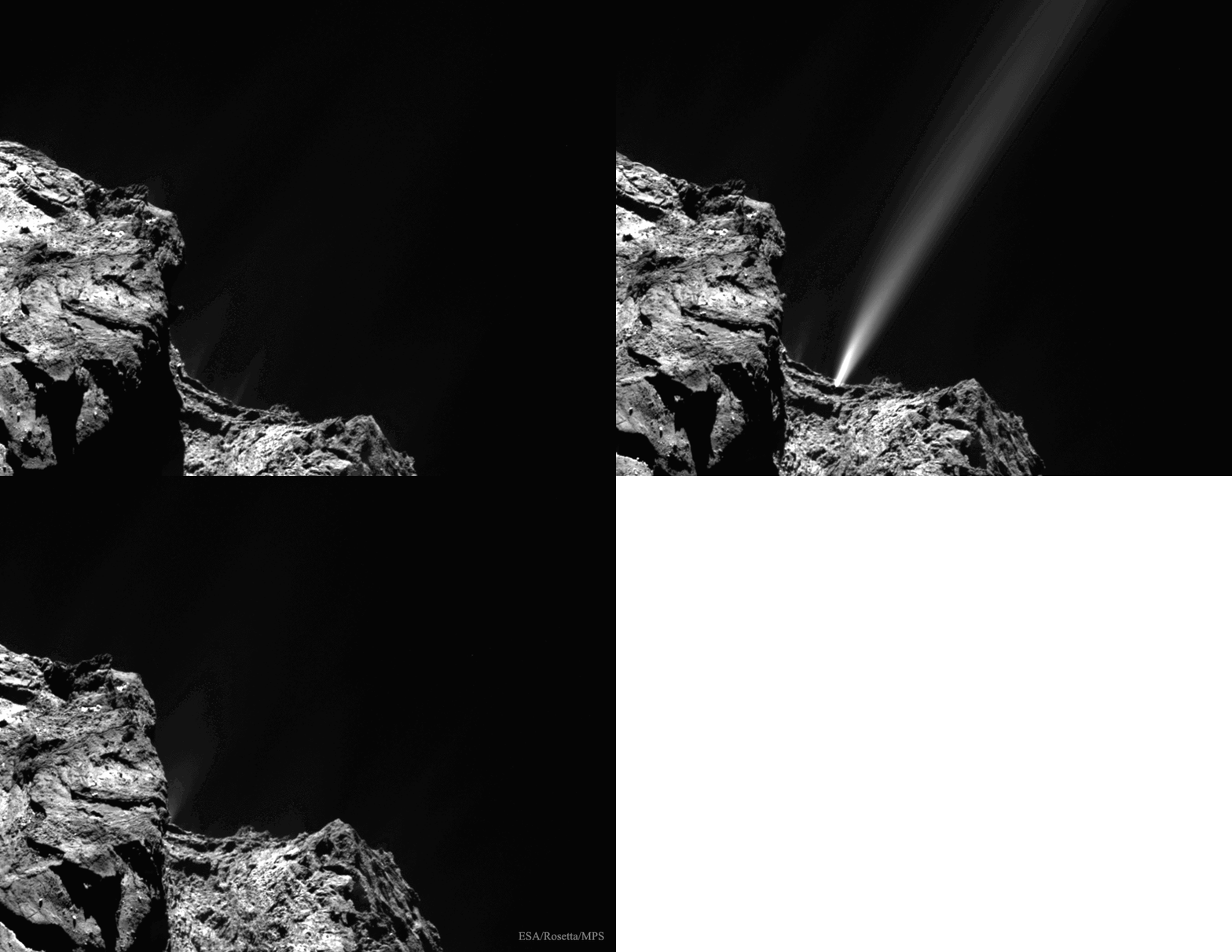
There she blows! A dramatic demonstration of how short-lived some comet jets can be was documented in late July by the robotic Rosetta spacecraft orbiting the nucleus of Comet 67P/Churyumov-Gerasimenko. The featured animation depicts changes in the rotating comet with three illuminating stills. Although the first frame shows nothing unusual, the second frame shows a sudden strong jet shooting off the 67P's surface only 20 minutes later, while the third frame -- taken 20 minutes after that -- shows but a slight remnant of the once-active jet. As comets near the Sun, they can produce long and beautiful tails that stream across the inner Solar System. How comet jets produce these tails is a topic of research -- helped by images like this. Another recent Rosetta measurement indicates that the water on Earth could not have come from comets like 67P because of significant differences in impurities. Comet 67P spans about four kilometers, orbits the Sun between Earth and Jupiter, and has been the home for ESA's Rosetta spaceship since 2014 August. Rosetta is currently scheduled to make a slow crash onto Comet 67P's surface in late 2016.