The Sun
The Sun is a yellow dwarf star (G2V), about 4.6 billion years old, and the dominant gravitational force in the Solar System. It has a diameter of roughly 1.4 million kilometers and contains around 99.8% of the Solar System’s mass. Nuclear fusion in its core converts hydrogen into helium, producing energy that warms the planets. Above the core lie the radiative and convective zones, followed by the visible photosphere (~5,500 °C), the chromosphere, and the much hotter corona (~2 million °C).
Source: science.nasa.gov
APODs including "The Sun"
Icelandic Legends and Aurora
08/12/2015
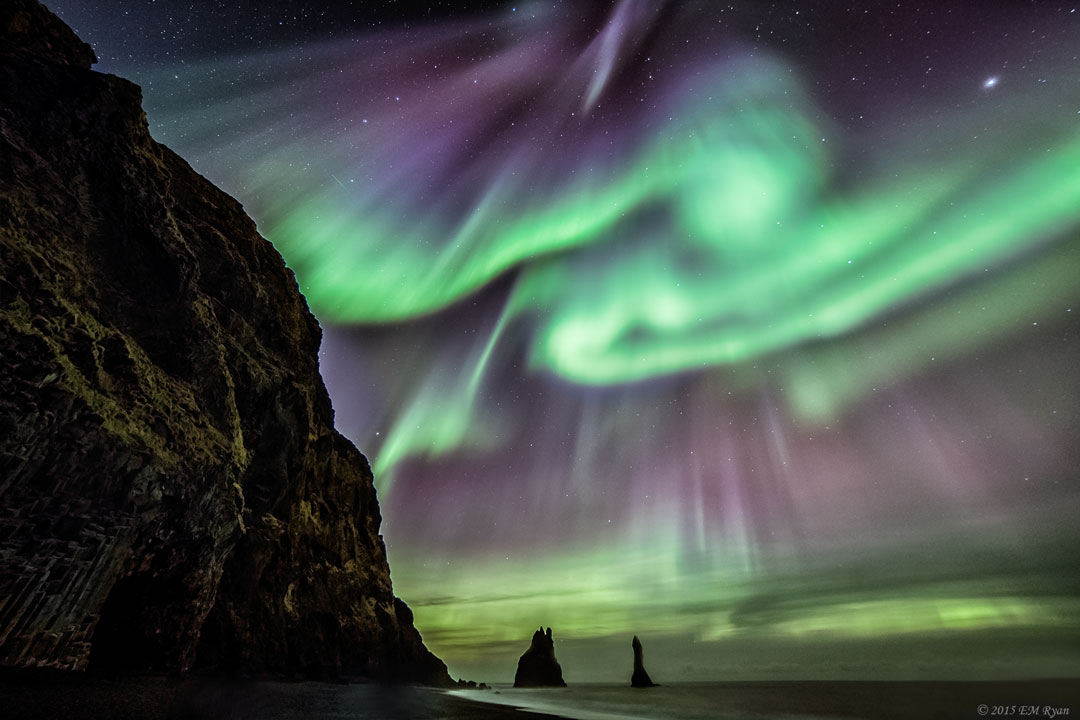
Legends collide in this dramatic vista of land, sea, and sky. The land is Iceland, specifically V�k � M�rdal, a southern village known for its beautiful black sand beaches. The sea, the Atlantic Ocean, surrounds Reynisdrangar, a sea stack of eroded basaltic rock pillars that Icelandic folklore tells are the petrified remains of trolls once attempting to drag a three-masted ship onto land. Watching from overhead and shining bright on the upper right is the god of the sky, according to Greek mythology: the planet Jupiter. Also visible in the sky are several other Greek legends encapsulated as constellations, including a lion (Leo), a big bear (Ursa Major), and a water snake (Hydra). One might guess that all of this commotion caused the spectacular aurora pictured -- but really it was just explosions from the Sun.